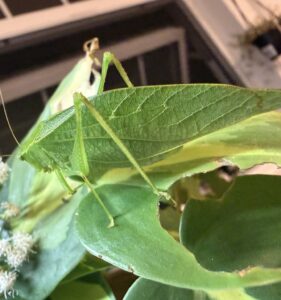
A leaf that learned to sing
On the evening of September 19, in Fox Chapel, this katydid was resting on a leaf whose surface had already been chewed through here and there. It did not need the holes to hide. Sitting with its wings folded high over its back, it was almost the shape and green of the leaf itself, and I only noticed it because my eye caught an edge that was too neat to belong to the plant.
It is the lesser anglewing, Microcentrum retinerve, a member of the katydid family Tettigoniidae in the order Orthoptera. The English name comes from the wings, which fold into an angled roof over the body, and from the species being the smaller of the two angle-winged katydids common in eastern North America. Both share the same trick: green, leaf-shaped wings with veins arranged like the veins of a leaf, so that a resting katydid reads as foliage until it moves.
Angle-winged katydids are arboreal. They spend their days pressed against leaves and branches in the canopy, feeding on foliage and coming alive at night, when the males begin to sing. The song is produced by rubbing the forewings together, and on a warm late-summer night it is one of the steady background sounds of an eastern wood, a dry ticking that most people hear without ever seeing the singer.
For now this one is recorded as M. retinerve on the strength of the photographs alone, and is still awaiting community confirmation. Given that it was perched on a leaf already full of holes, it had picked its hiding place well, and it stayed still enough that I eventually left it to its camouflage and its evening.
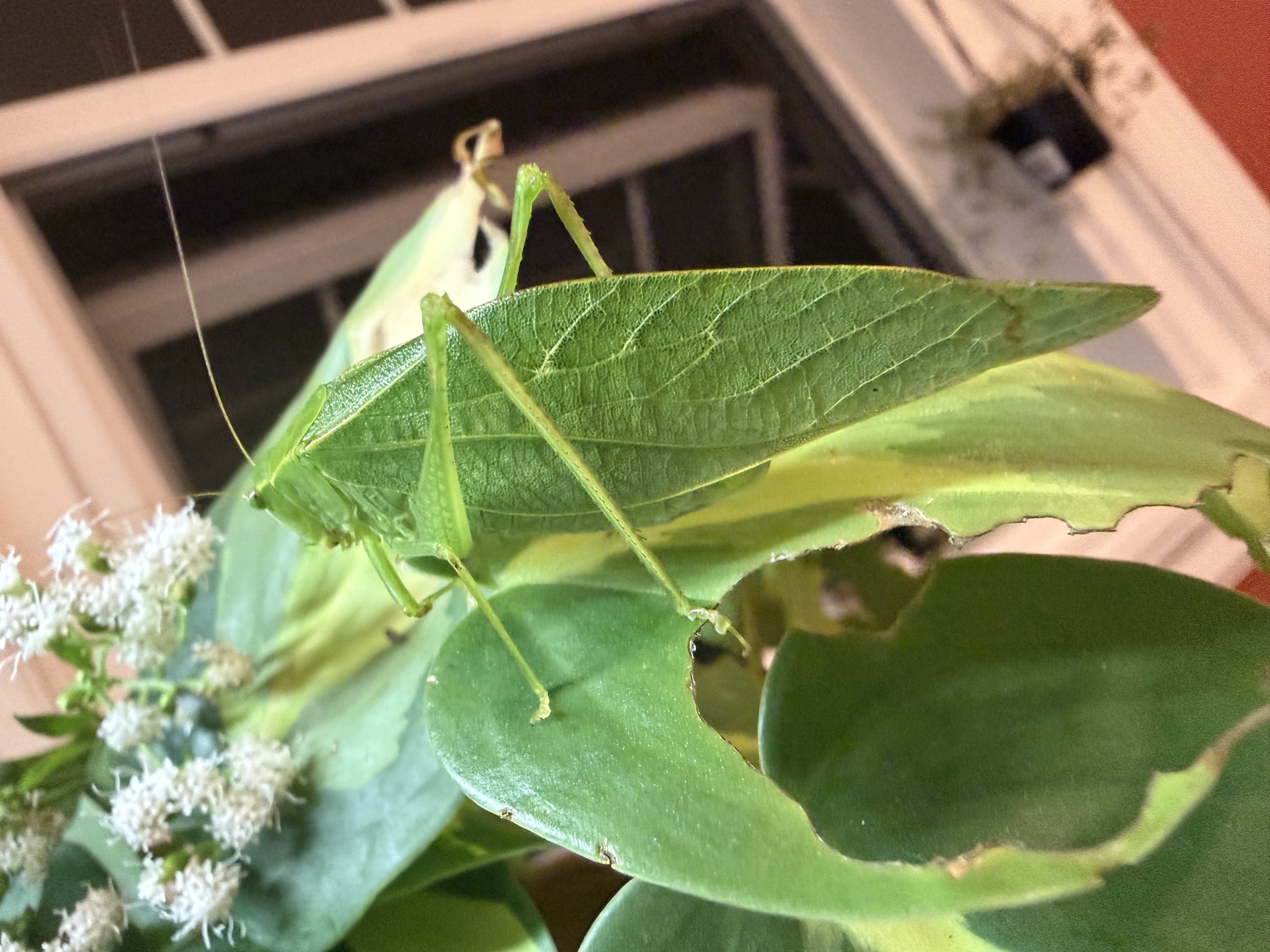
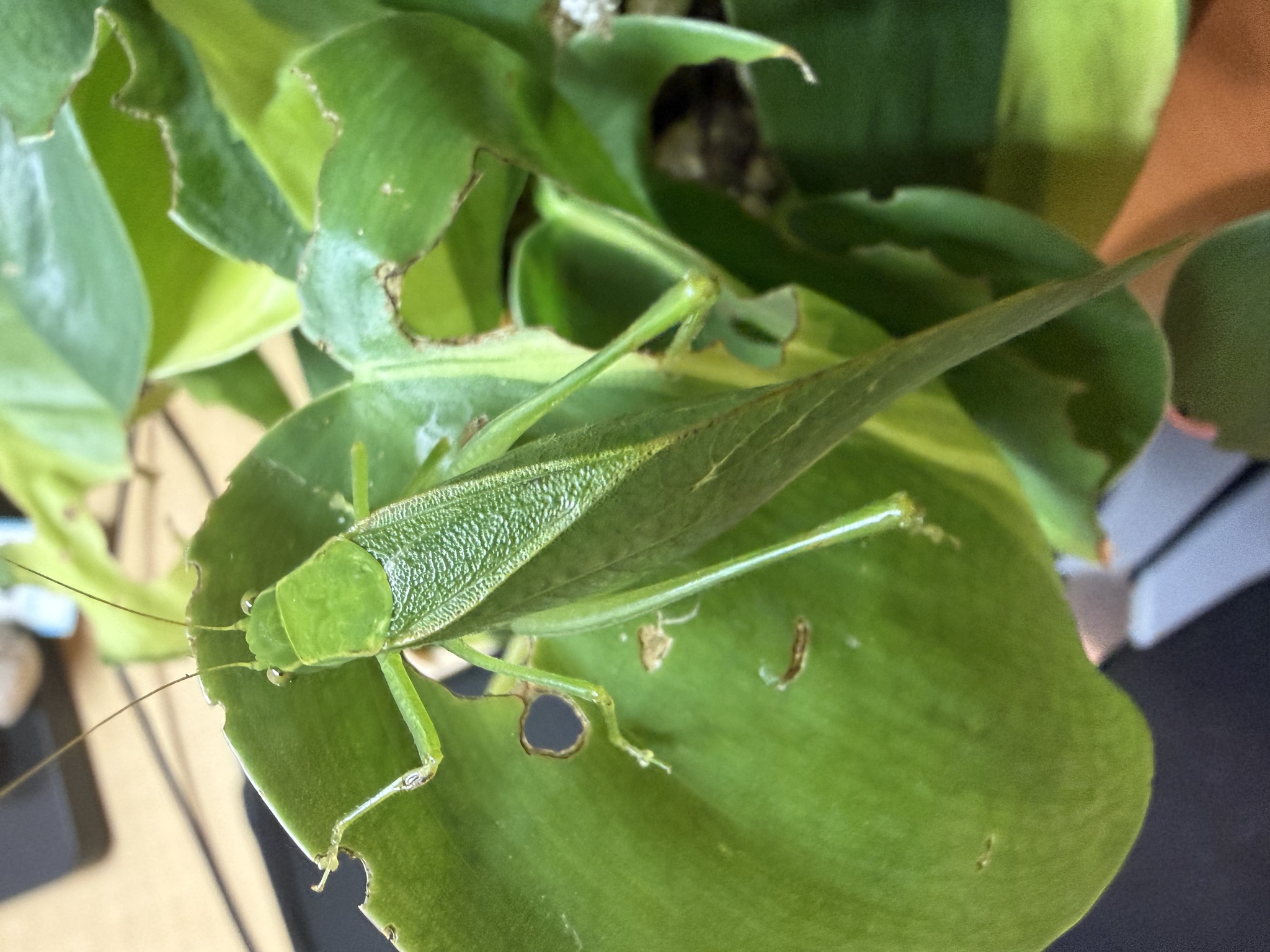
Great camouflage shot. I have always wondered how you tell Microcentrum retinerve apart from M. rhombifolium in the field when you cannot hear them — is the wing vein pattern in photos like these reliable enough on its own, or does it usually take the song to be sure?
Glad you liked it — and that is exactly the right question to ask about this photo.
Short answer: wing venation alone is not reliable enough, and I would not want to defend the ID on it. The two angle-wings overlap in size more than the names suggest, and the venation is best seen on the male’s stridulatory field, which needs a flat, sharply lit close-up that resting photos like mine rarely provide. Even then, intraspecific variation and the angle of the shot make it shaky.
In practice the song is the field character that settles it — the lesser anglewing’s dry, fast ticking versus the greater anglewing’s slower, lisping zip — and, in the hand, the size and the tooth count of the stridulatory file under magnification. Size helps in photos, but only as a hint.
So yes: this one is photo-only for now, which is why I flagged it as awaiting confirmation rather than calling it settled.