A field guide to the insects around our campus
By Xuanye (Peter) Liu
There are two communities on this campus, and only one of them knows your name. The one you belong to keeps a bell schedule. The other keeps a different calendar entirely: light, warmth, the length of the night, the last warm week before the frost. Nobody runs it, nobody joined it, and it has been here longer than the buildings. It will still be here after the last practice ends and the lights go out. It was three years ago, when I first came here, that I first became involved with this community.
I have been at this school a little over three years, both weekdays and weekends. On the way to class, in the half hour before practice, and above all on weekends, when the buildings go quiet and the grounds belong to whoever is willing to walk slowly, I’ve been observing. Countless afternoons, most of them ending with nothing at all, a few ending with something I had never seen before.
What follows is the latest record: 11 species of insects, every one of them found within a few minutes’ walk of the senior school in the past few months. Not on a field trip. Not in a rainforest. Here, between buildings, along the weed line at the edge of the field, on the flowers by the walkway, on a porch light, on a window screen, once on a plastic bag somebody had dropped.
The old habit is to assume that small means mindless, that an insect is a machine running on reflex. However, I do not think these animals are simple. Watch a jumping spider turn to follow you across a room, or a mantis turn its head to keep you in view, and the assumption gets harder to hold. I have no proof of anything. I only know that the closer I look, the less like a machine they become.
None of them are dangerous to anyone who isn’t an insect, and most are easy to find once you know what to look for.
I arranged them by classification, family after family. Every photograph below is one I took on or near campus.
Orthoptera — the crickets, katydids, and their kin
Tettigoniidae — the katydids
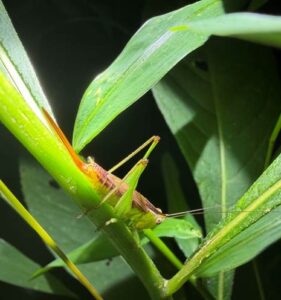
Short-winged meadow katydid (Conocephalus brevipennis)
Insecta › Orthoptera › Tettigoniidae › Conocephalus
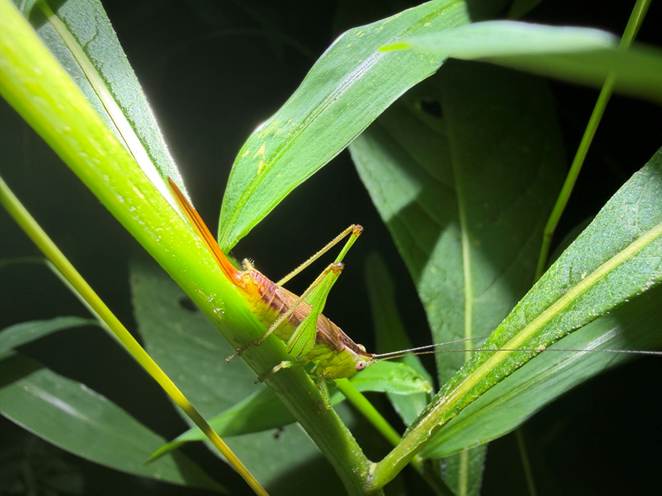
Brevipennis means exactly “short-winged”, and the whole genus shares the trait, as though it traded flight for secrecy. These are singers. Males rub their forewings together at dusk and into the night. Each species has its own rhythm, and this one’s soft raspy buzz is easy to lose inside the louder chorus of late summer. It is common across North America in grassy fields, weedy edges and meadows. The insects are plentiful enough that almost everyone hears them and almost nobody sees one. What I liked was the commitment: it had wings, and it chose to sit still and let the green do the work. In a field of green stems that is the best invisibility a small insect can have, and it was working perfectly, right up until the moment I happened to look closer.
Oblong-winged katydid (Amblycorypha oblongifolia)
Insecta › Orthoptera › Tettigoniidae › Amblycorypha
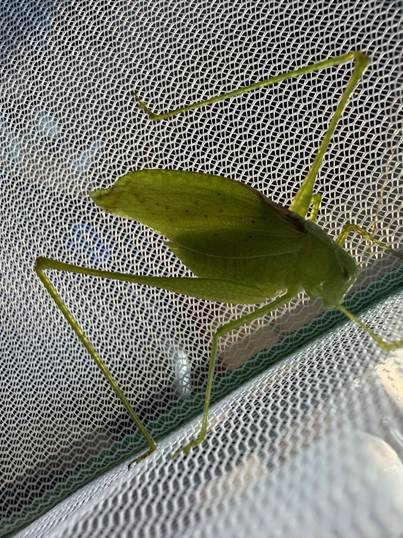
A leaf that got up and walked, but the long antennae gave it away, sweeping forward like two delicate threads. This is one of the broad-winged katydid, a group that leans entirely on leaf mimicry, and does it so well that the species name refers to the wings rather than to any plant: oblongifolia means oblong-leaved, because the closed forewings are drawn out and rounded at the tip like a small leaf. These creatures are solitary and mysterious, they live in the understory of deciduous woods and along bushes They eat strictly plants: leaves and flowers, with recorded tastes including jewelweed, goldenrod, arrowhead and wild grape, and no interest at all in grasses. It is not a pest of anything we grow. On late summer nights the males call from the foliage with a rapid clicking sound by rubbing their wings together, and the female answers with a short tick of her own, the two of them building a bond across the dark. They are green leaves that get up, walk, and sing when the light goes.
Lesser anglewing (Microcentrum retinerve)
Insecta › Orthoptera › Tettigoniidae › Microcentrum
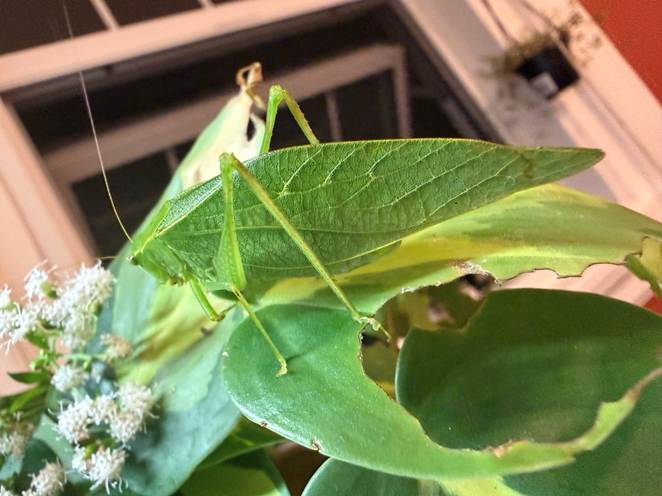
At a first glance, this insect looks exactly like the last one. But it is obvious after a close observation that it is larger in size and lacks the brown markings on the back. The name Lesser anglewing comes from its wings that are folded in an angle, and from being the smaller of the two angle-winged katydids common in eastern North America. Both share the same trick: green wings with veins laid out like the veins of a leaf, so that a resting katydid reads as foliage until the moment it moves. They are arboreal, pressed against leaves and branches in the canopy by day, feeding on foliage. However, they come alive after dark, when the males begin to sing by rubbing the forewings together. On a warm late-summer night that song is one of the steady background sounds of an eastern wood: a dry ticking that most people hear their whole lives without ever seeing the singer.
Oecanthidae — the tree crickets and their relatives
Jumping bush cricket (Hapithus saltator)
Insecta › Orthoptera › Oecanthidae › Hapithus
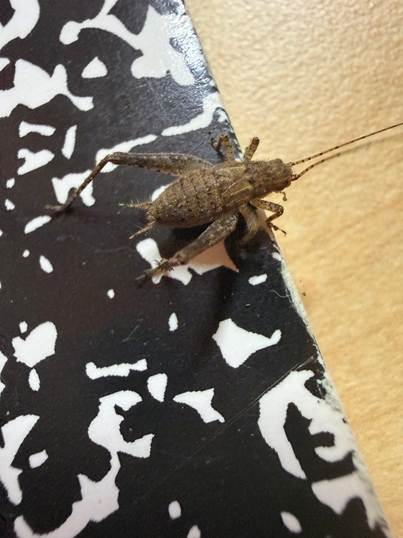
Though wingless as a nymph, it came in when I forgot to close my windows. It stayed perfectly still while the camera moved in, and it stayed still right up until I shifted too close, and then, it was simply gone, launched upward in a single sharp leap that my eyes cannot follow. That is where the name comes from: saltator is Latin for dancer, or jumper. The long antennae, the folded wings covering the abdomen, the heavy hind legs built for sudden launches . Everything about it is tuned to that one explosive escape. These are nocturnal crickets. By day they shelter in shrubs and low vegetation; after dusk the males start to sing, a rapid repeated trill from somewhere inside the bushes.
Broad-winged tree cricket (Oecanthus latipennis)
Insecta › Orthoptera › Oecanthidae › Oecanthus
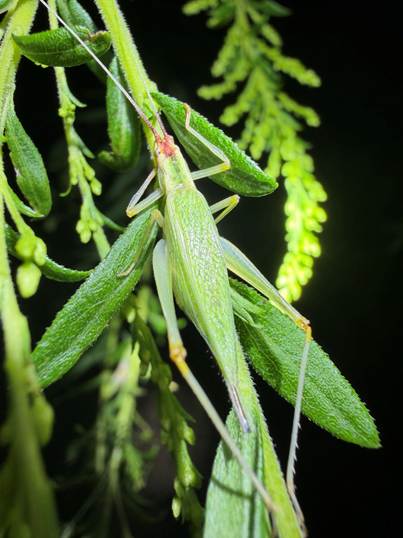
A pale green tree cricket among the leaves in the September dusk, easy to walk past and easy to overlook: slender, translucent, wings folded flat over the back like a neatly closed coat. The giveaway is in the name. latipennis, from the Latin latus (broad) and penna (wing), for the broad flattened wing covers of the male. One of its relatives, the snowy tree cricket, calls at a rate that tracks air temperature closely enough to be used as a living thermometer, and counting its chirps to guess how warm it is is a genuine piece of skill rather than a folk tale. The females lay their eggs by drilling neat rows of holes into plant stems and twigs with their ovipositors; the eggs wait out the winter and hatch the following spring. By day these crickets are masters of hiding in plain sight, their pale green matching exactly the leaves they rest on.
Gryllidae — the true crickets
Pennsylvania field cricket (Gryllus pennsylvanicus)
Insecta › Orthoptera › Gryllidae › Gryllus
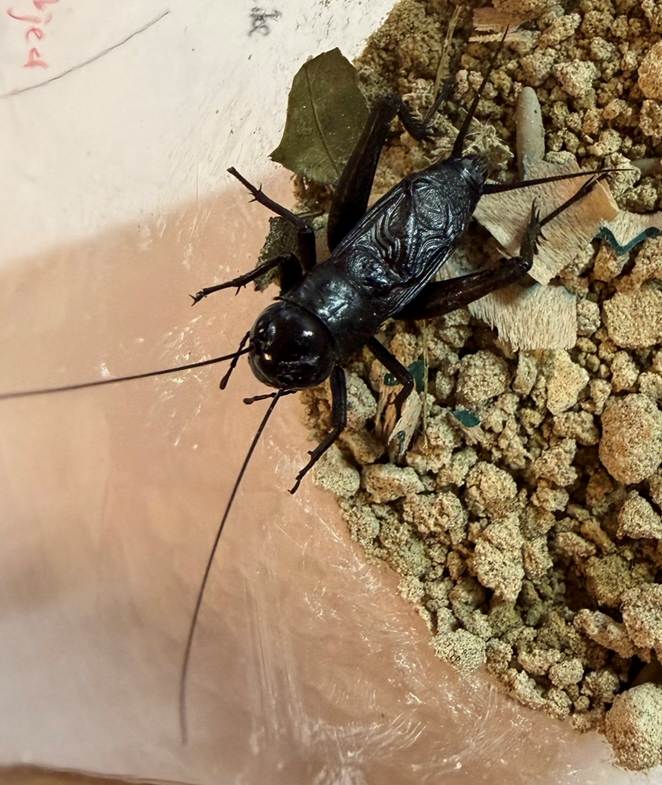
Out on the ground among soil and fragments of dead wood, with long antennae sweeping ahead of it. It stayed put while I crouched down, and only slipped away into the shadows when I leaned in close. The name carries local history: pennsylvanicus means Pennsylvania, and the species was described from this which makes it, in a small way, ours. Although the Mica fighting cricket originally from east Asia thrives in the American continent nowadays, across much of eastern North America, this native dweller is still one of the most familiar crickets of late summer and autumn, living in grass and disturbed ground, fields and forest edges, and delivering a crisp, bell-like call.
Mantodea — the mantises
Mantidae — the praying mantises
Chinese mantis (Tenodera sinensis)
Insecta › Mantodea › Mantidae › Tenodera
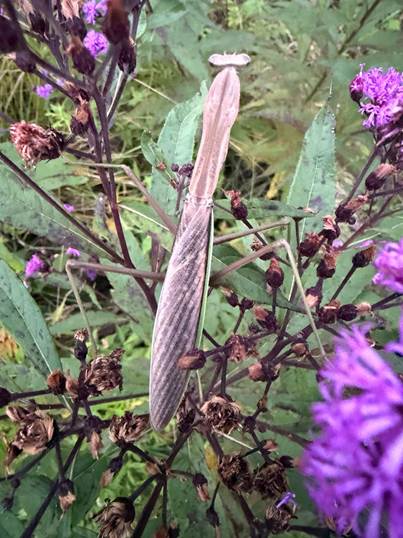
It has always reminded me of home whenever I see it. Back in the days, I used to see them most often in Beijing, praying on the bushes with its claws clinging on to its prey. Maybe because of its efficiency in eliminating pests or simply by accident, it was introduced into the continent of America. Its adults reach seven to ten centimeters, which makes this one of the largest mantises in North America, and the species comes in green and brown forms; this one was a soft brownish grey with darker stripes along the folded wings. It is an ambush hunter, and a patient one: it will sit for hours, swaying faintly like a leaf in a breeze, then strike with its raptorial forelegs in a fraction of a second when a cricket or a moth wanders within reach. Although male mantises might fly all over the campus, female ones are often seen on bushes of purple flowers at the Far Field.
Hemiptera — the true bugs and cicadas
Reduviidae — the assassin bugs
Wheel bug (Arilus cristatus)
Insecta › Hemiptera › Reduviidae › Arilus
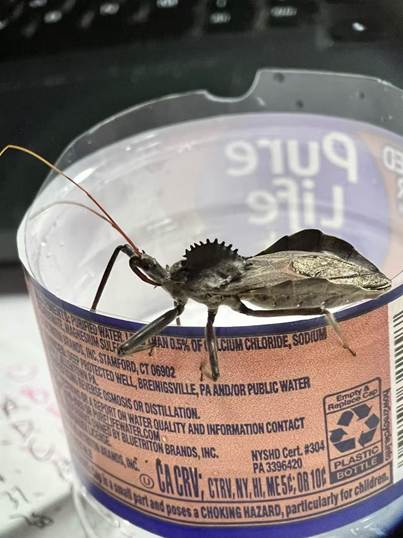
I almost walked right past it on campus: something grey and oddly mechanical sitting motionless on a leaf, and then the giveaway a perfect half-wheel of gear teeth rising off its back made me take a second look. Nature does not usually build steampunk, but this time it made an exception; no other insect in North America wears a crest like that. This unique feature is hinted at in the insect’s name; cristatus means crested. Arilus cristatus is a giant of the assassin bugs (use the cup in the image for comparison). It moves in the deliberate, unhurried way of a hunter that knows nothing in the garden is faster than it is, and it hunts the way the family does: sitting still, then striking with a short piercing beak, the rostrum, and injecting enzymes that dissolve the prey from within before it is drained. Look, don’t touch: its sting is genuinely painful, and it is one of the very few insects on this campus worth a healthy respect. I have found it twice now, a nymph and an adult, both times here.
Spiny assassin bug (Sinea spinipes)
Insecta › Hemiptera › Reduviidae › Sinea
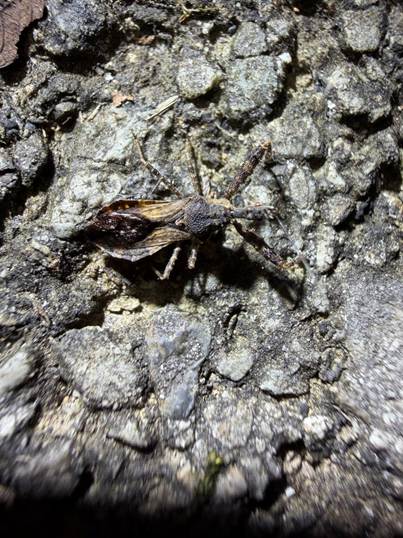
Another assassin bug, notably smaller than the last, sitting motionless on a low stem, so still that it read as a stray fleck of dried vegetation. I only registered it at the last moment, and when the camera came close it turned a wary head and tracked the lens. spinipes means spiny-footed, from the Latin spina (thorn) and pes (foot), and the name is the point: the long legs carry rows of spines that help it seize and hold struggling prey, a built-in grip for a bug that has to win its meal in a single sudden lunge. Sinea is a North American genus of ambush hunters, at home along roadsides, forest edges and open fields, and like the rest of the family it does not chase anything: it waits, then strikes with a short piercing beak and enzymes that dissolve the prey from inside. This one never moved a leg during our whole encounter. By the time I left, it was still there.
Cicadidae — the cicadas
Dog-day cicada (Neotibicen sp.)
Insecta › Hemiptera › Cicadidae › Neotibicen
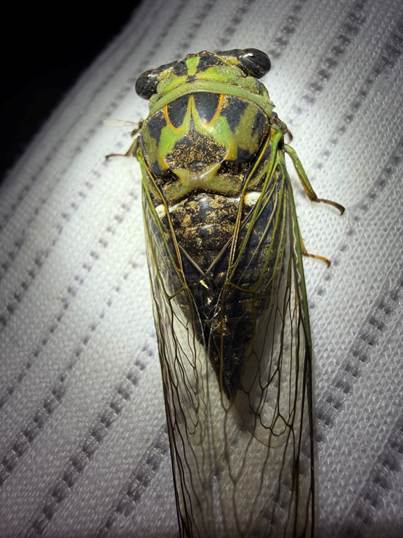
Attracted by the light of my room: this insect had black body patterned with green and yellow, transparent wings spread with dark veins like stained glass. It sat completely still and unbothered, doing what dog-day cicadas do best: nothing, loudly, all summer long. The common name comes from the dog days of late summer, the hottest stretch of the year, which is exactly when these cicadas sing. The chorus at the end of August is one of the defining sounds of a Pittsburgh summer, the sound you stop hearing, and then suddenly notice again. Like other cicadas, the nymphs spend years underground feeding on tree roots, and emerge as adults for a few weeks of singing and breeding. Years in the dark, then one loud month in the sun.
Lepidoptera — the moths and butterflies
Erebidae — the litter moths and their kin
Litter moths (Herminiinae)
Insecta › Lepidoptera › Erebidae › Herminiinae (subfamily)
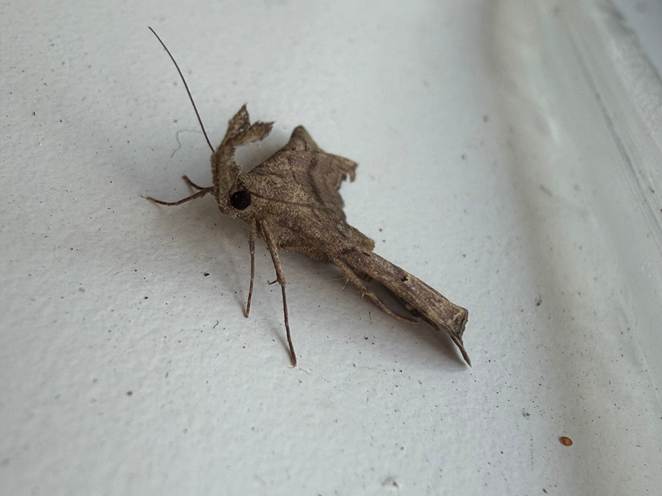
It looked less like an animal than a scrap of bark or a fleck of old leaf, which is very much the point. Herminiinae, the litter moths, is a subfamily of the huge family Erebidae, and the name is literal. The caterpillars of most litter moths feed on dead, fallen leaves rather than living foliage, working their way through the leaf litter of woods and gardens. The adults are slender and long-legged, with wings that fold tightly back and a habit of resting low on trunks, on stones, anywhere the colour of the day happens to match them. That camouflage is exactly what makes them hard to admire and harder to identify: litter moths run to muted browns and greys, and many species look much alike, so a photograph taken at rest is often enough to place one in the subfamily and no further. For now this one is recorded at subfamily level and awaits confirmation. A small reminder that a dead leaf on the ground is not wasted: for a whole group of moths it is dinner, and for the moths themselves it is the best disguise going.
How to actually find them
- Slow down. That’s most of it. I found the wheel bug because I stopped walking.
- Look at edges. The weed line at the edge of a field, flower stems, fence posts, the undersides of leaves. Neat lawns are boring; messy margins are busy.
- Go out at night. A porch light or a flashlight will find you more in ten minutes than an hour in the afternoon. Most of this list is nocturnal.
- Don’t grab. Look, photograph, move on. Assassin bugs and wheel bugs can bite, and even the harmless ones don’t enjoy being held.
- Photograph, then check. I don’t identify everything on the spot, and neither should you. Post a picture somewhere and let other people weigh in; several of the records above are still waiting on confirmation from people I’ve never met.
Why bother
None of this is important in the way that grades and games are important.
But I keep coming back to the same thought. For three years I walked the same paths as everyone else, and for three years a whole community was holding its note just out of earshot : singing at night, sitting on the flowers, hiding in the grass at the edge of the field. It was never hidden. I simply was not looking.
Attention is the whole trick. Not expertise, not equipment, just the decision to stop, once, and wait a minute longer than you meant to.
Of course, these are not all the insect species present around our campus. In fact, they may represent less than one-tenth of the total number of species (maybe I should reconsider naming this “field guide”). But my effort to look for new insect species will never end and could possibly contribute to the next edition.
I really enjoyed this — the framing of a second community with its own calendar is a nice way to put it, and finding eleven species between buildings is more than most people would expect from a campus. Two things I would love to know: is this list essentially a late-summer snapshot, or have you been recording through the whole year? I would guess spring looks quite different, with fewer singers and more things tied to fresh growth. And since the Chinese mantis is introduced there, have you noticed it overlapping much with the native Carolina mantis on the same grounds, or do they seem to sort themselves out by habitat?
Thanks — glad the “second community” framing landed. Two honest answers:
On the season: this list is essentially a late-summer snapshot. The records cluster in late August 2026 (the two dated entries are 8/28 and 8/29), gathered over a few months of walking the grounds rather than a standardized year-round survey. So it should be read as “what was findable and identifiable in late summer”, not a campus inventory. Spring would look quite different, and your intuition is right: fewer singers (most of our Orthoptera are late-summer and autumn voices), more species tied to fresh growth, plus overwintering nymphs and early-emerging things that are small, quiet and easy to miss. Detectability shifts as much as the fauna does.
On the mantises: neither appears in this 11-species list yet, but both are on campus. The Chinese mantis (Tenodera sinensis) is the introduced one; the Carolina mantis (Stagmomantis carolina) is native. In practice they overlap on the same grounds but tend to sort by vegetation structure and phenology rather than by strict territory — Chinese mantis more often in taller grass, forbs and ornamental beds, maturing later in the season; Carolina more often on shrubs and in lower, denser vegetation, maturing earlier. That is a tendency, not a hard partition: they can turn up within metres of each other. I will keep watching and add the first mantis record when I get a clean one.