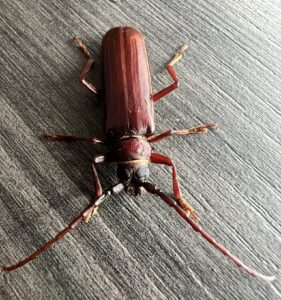
A lumberjack of the night
On a July night in Pittsburgh, a large brown beetle was clinging to the wall beside a porch light, looking like it had flown in from a different century. Its antennae were long and saw-edged, its body heavy and blunt, and it sat there without moving as if the light were the only thing in the world worth attending to. Close up, its mandibles looked strong enough to split a pencil, a hint of the wood-chewing life it had left behind.
This is Orthosoma brunneum, the brown prionid, a member of the longhorn beetle family Cerambycidae in the order Coleoptera. The prionids are the lumberjacks of the longhorn world: big, broad-shouldered beetles whose larvae spend years tunneling through dead and decaying wood, grinding it down with powerful jaws. This species favors pine and other conifers, and in the forests of the eastern United States it is one of the largest beetles you are likely to meet.
The adults live for a short, bright chapter of the story. They rarely feed much, their business being to find each other and start the next generation, and they are strongly drawn to lights, which is how so many of them end up on porches in July. The serrate antennae, each segment notched like a saw blade, are a prionid trademark.
The name Orthosoma combines the Greek words for “straight” and “body,” and brunneum simply means “brown.” A straight, brown body built for a life inside wood: the name is almost a job description.
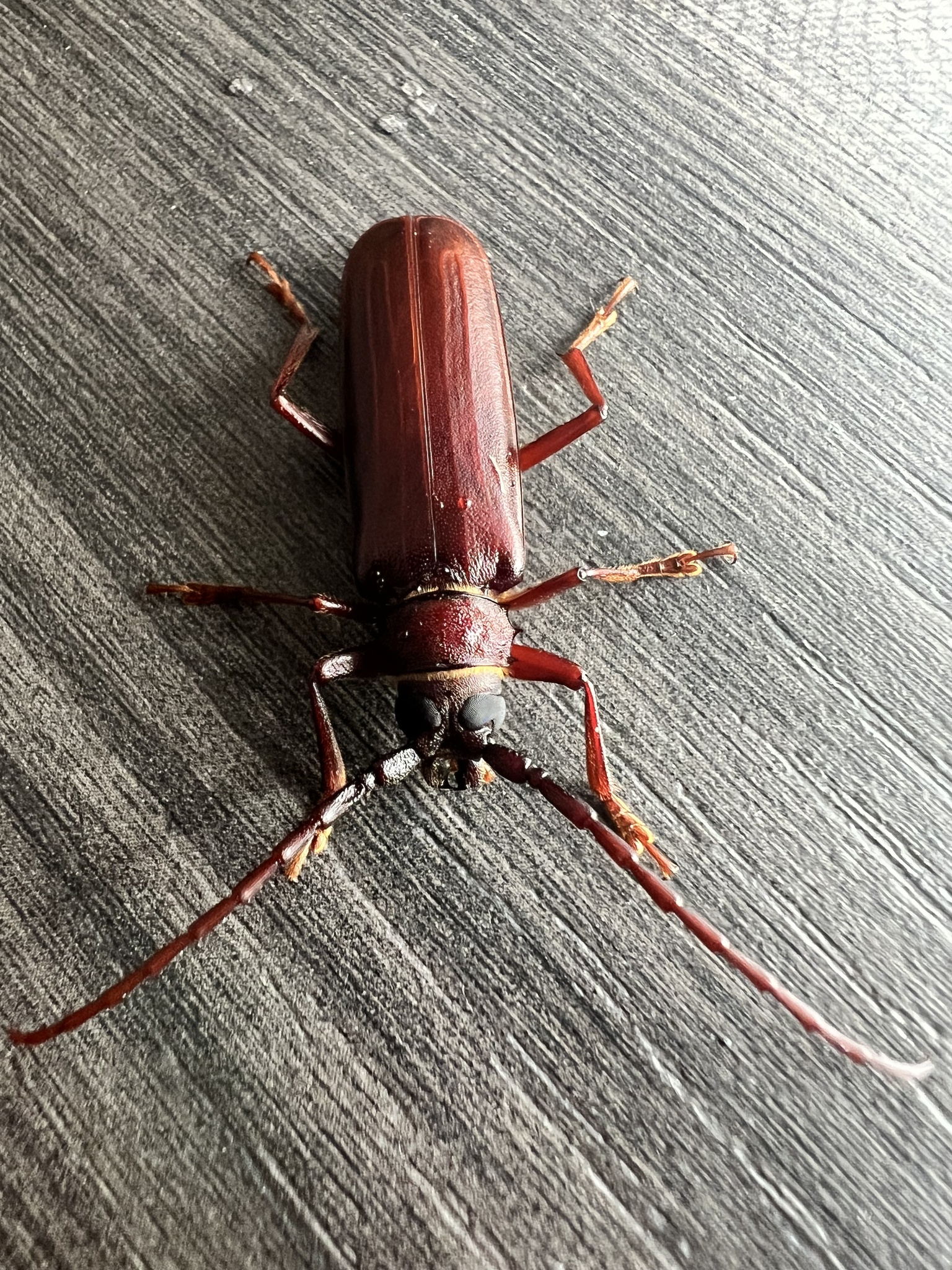
Since the adults barely feed and mostly focus on finding a mate, do they survive purely on energy stored up from the larval stage? Also, how long does the larval stage typically last inside the wood?
That’s the trick: they don’t really need to eat as adults because the larva did all the eating for them. Orthosoma brunneum larvae spend years tunneling through decaying pine and other conifers, packing away energy reserves, and the short adult phase just spends that down. Adults typically live only a few weeks, just long enough to find a mate and for the female to lay eggs in dead wood, and then they’re done. Some longhorn adults do sip sap or nectar now and then, but for prionids like this one feeding is mostly optional. Short life, one job, no grocery runs required.