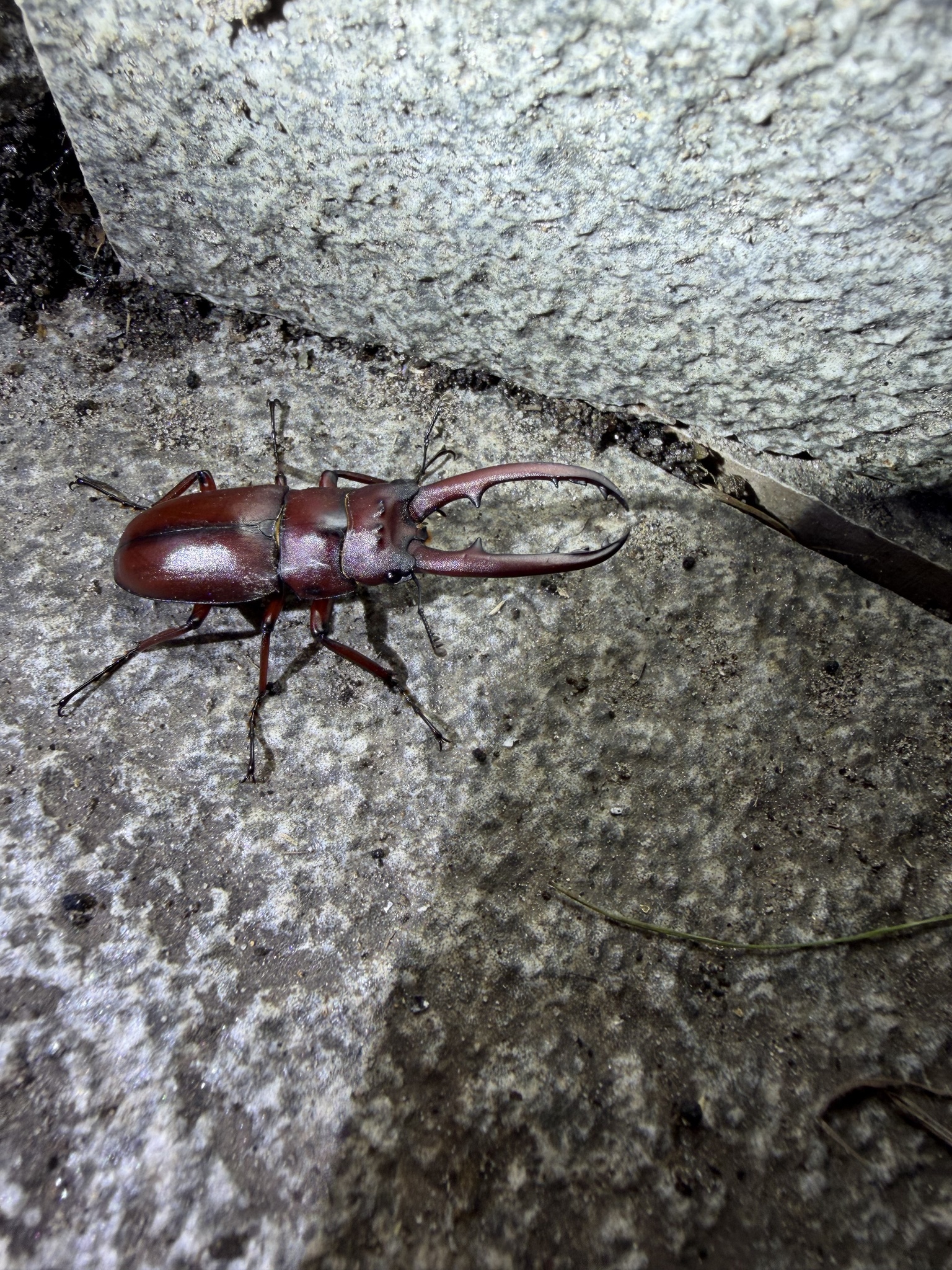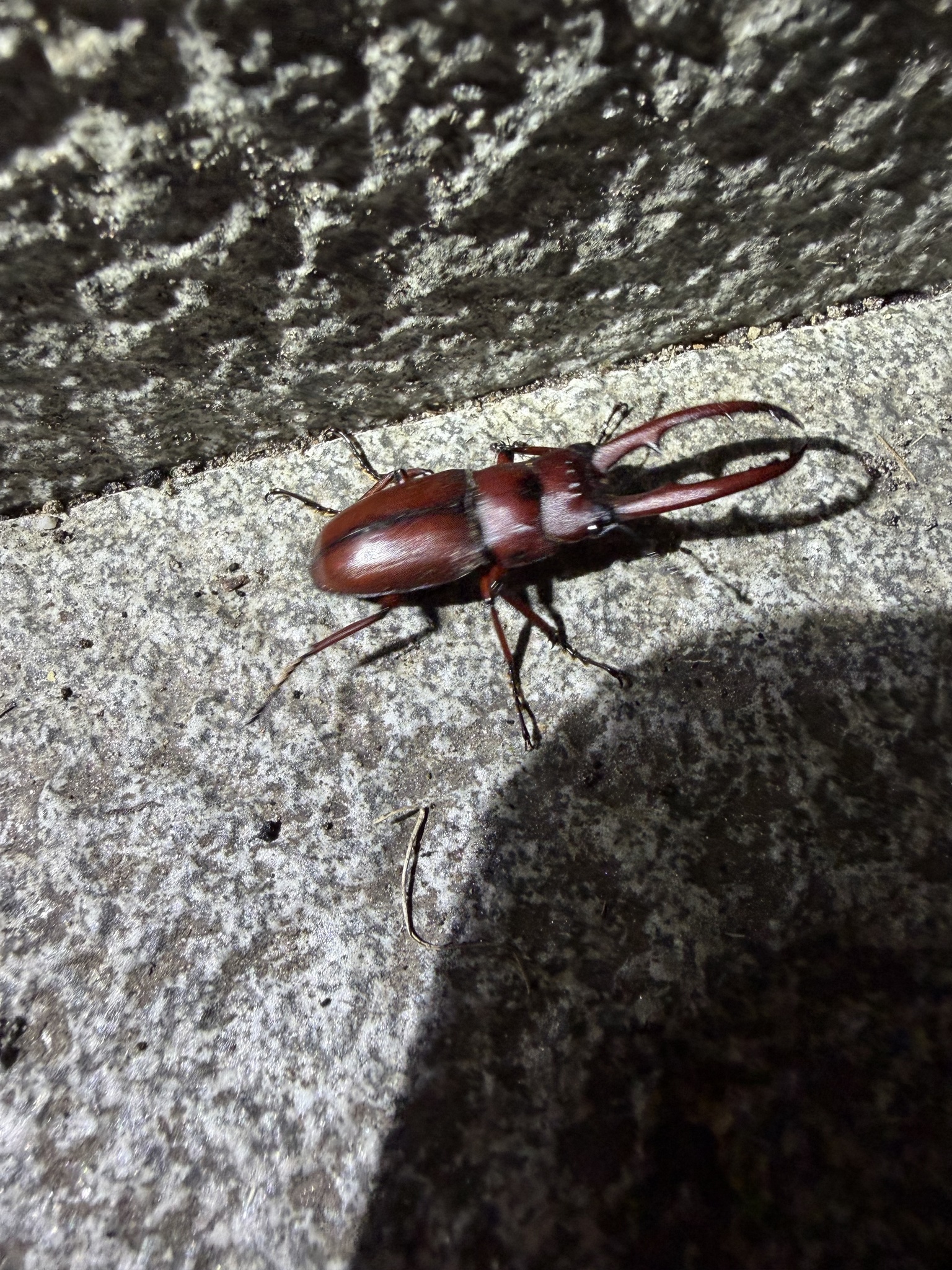
A deep red stag beetle on a stone wall
Medog, 27 June. This stag beetle was resting on rough rock at the foot of a gray stone wall, its deep red body standing out sharply against the grey. Two long, curved horns swept forward from its head, and it sat motionless, watching the world with the patience of something that had spent years underground before this brief season in the light. I crouched down, and it did not so much as twitch an antenna.
This is Prosopocoilus laterotarsus, a member of the stag beetle family Lucanidae in the order Coleoptera. The genus Prosopocoilus is a large one, the saw stag beetles, named for the saw-toothed inner edges of the males’ mandibles. Medog sits at the southern foot of the Himalaya, where the great ranges drop into wet, forested valleys, and it is exactly this kind of corner that stag beetles seem to love.
Its life story is typical of the family: a larva feeding on rotten wood for a long stretch, then a short adult life of sap and ripe fruit. The long horns are the male’s mandibles, grown large for wrestling matches with other males over the best feeding spots. What looks like a weapon is really a badge of status, brandished far more often than it is used in earnest.
The species name laterotarsus combines the Latin for “side” and “foot”, a reference to the tarsi, the final segments of the legs. When a beetle with such showy jaws is named after its feet, it is a small reminder that taxonomists see everything, even the parts nobody looks at.