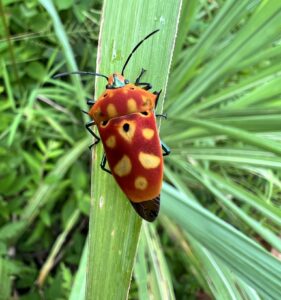
A jewel bug polished by the monsoon
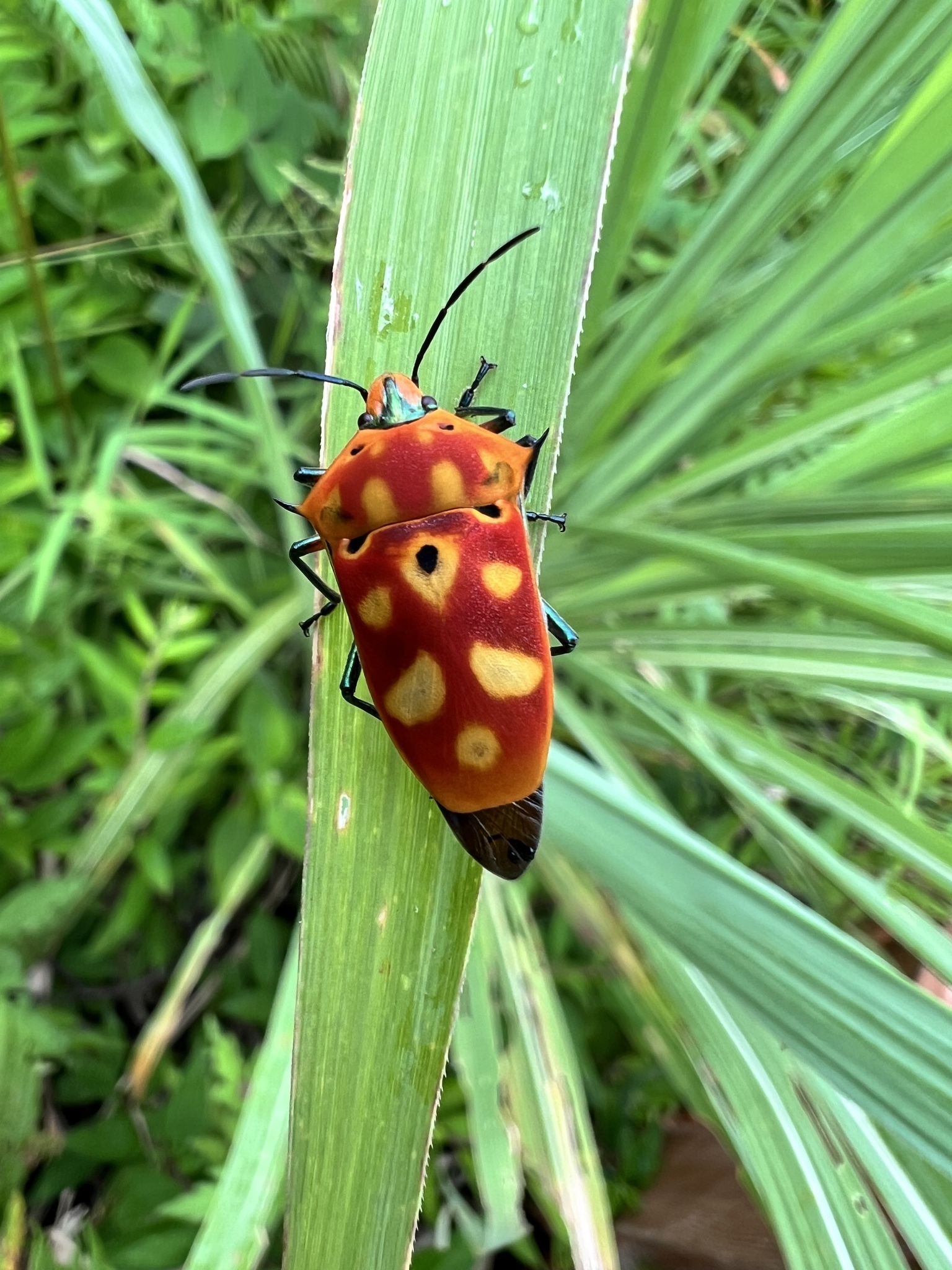
The forests around Medog were sodden with August rain when I spotted this one, and it looked like a piece of jewelry dropped on a leaf: bright orange, boldly spotted with black, the whole body rounded into a single glossy shield. It sat motionless, as if posing.
This is Cantao ocellatus, the ocellated shield bug, a member of the jewel bug family Scutelleridae in the order Hemiptera. The family name is deserved: many scutellerids are glossy and brightly colored, and in Cantao the scutellum, the plate that covers the thorax and abdomen, has grown so large that the bug looks like one smooth rounded dome with a head attached.
The species name ocellatus means “with little eyes,” and the black spots scattered over the orange back do look like staring eyes. Eye-spots are a classic defensive trick: they can startle a predator or draw an attack to a harmless spot. For a slow, armored bug that prefers to sit still, every bit of deterrence helps. Scutellerids are close relatives of the stink bugs, and like them they can release defensive chemicals when alarmed, though this one stayed calm throughout.
Jewel bugs feed on plant sap and are perfectly at home in the warm, wet forests of the eastern Himalaya. Seeing one glowing on a rain-darkened leaf in Medog, I understood exactly how the name “jewel bug” came about. The photo barely does justice to the gloss; in the rain the surface looked almost metallic. Nature’s jewelry department was having a good day.
Beautiful shot — the metallic sheen really comes through even in the rain. I have always wondered about those spots: in Cantao, are the black ocelli actually functioning as eyespots that startle predators, or are they just part of the warning colour pattern for a bug that is chemically defended anyway? And you mentioned this one stayed calm without releasing anything — does C. ocellatus have working scent glands as an adult, or is the big rounded scutellum its main defence at that stage?
On the spots, I would call it both, with the warning colour doing the main work. A bug this slow and this conspicuous is not hiding, and it is chemically defended, so the pattern is aposematic first. That said, paired round spots on a dome that sits still are exactly the configuration that startles a naive predator, and eyespot effects are usually strongest against birds and lizards that have not met the species before. Nobody has tested it in C. ocellatus as far as I know, so I would treat the startle function as plausible rather than proven.
On glands, the scutellum is armour, not chemistry. The chemical defence in scutellerids and their pentatomoid relatives sits in glands on the thorax and abdomen, and adults of most species keep working scent glands, which is why handling one is a poor idea. The one in my photos stayed calm and released nothing, but that is a choice rather than a missing capability.