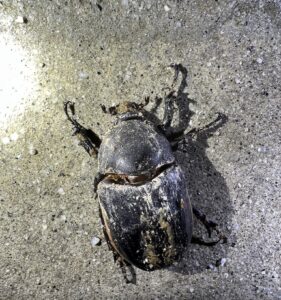
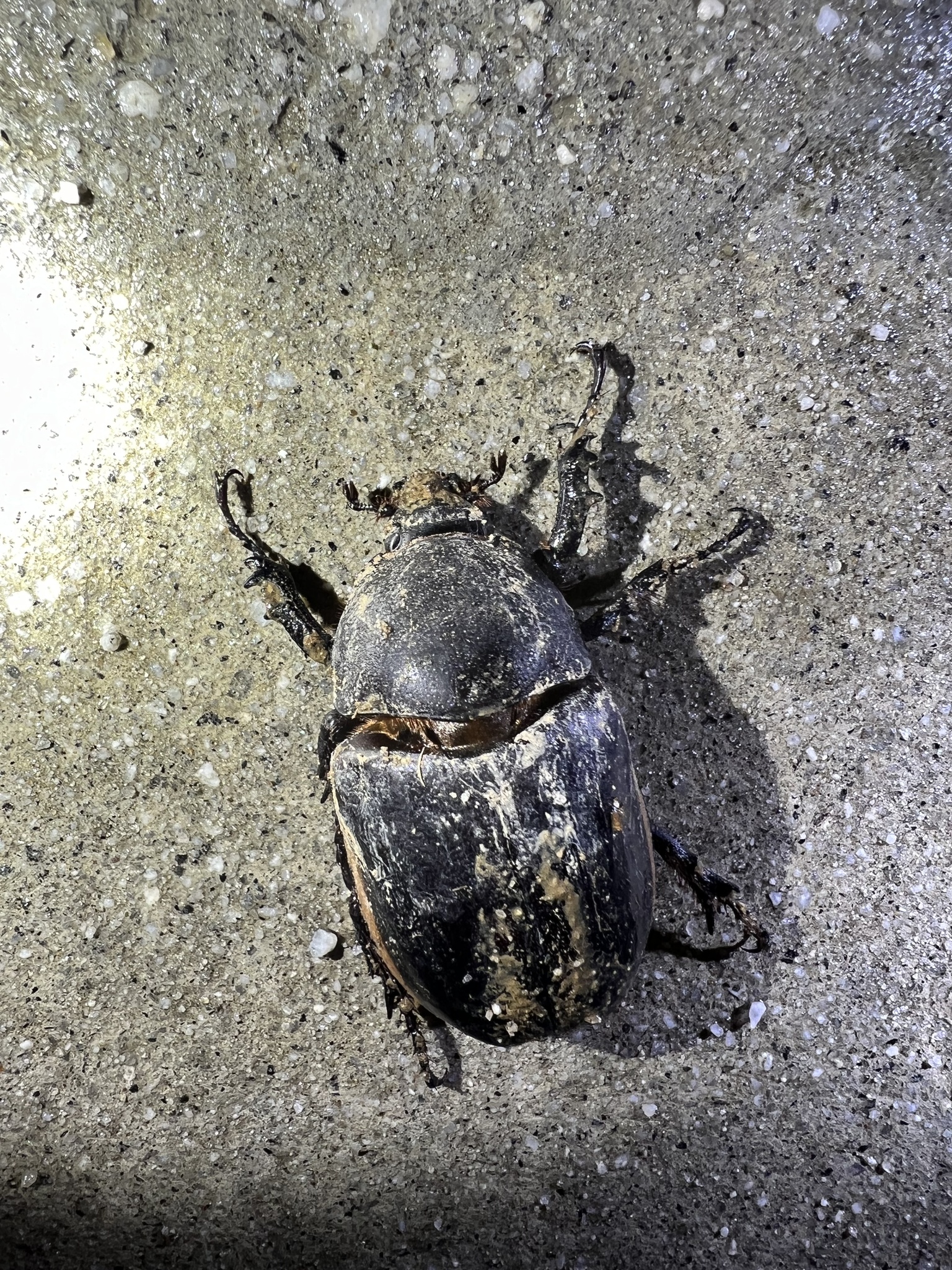
A five-horned beetle with nowhere to hide
Some beetles you photograph out of duty. This one I photographed out of awe. It turned up in Medog, Tibet, on 7 August 2024, a glossy, armoured giant with no shortage of horns and no apparent interest in being subtle about it. There was no mistaking it for anything else, and there was no hurrying the photograph either.
This is Eupatorus hardwickii, often written hardwickei, the five-horned rhinoceros beetle, a member of the scarab family Scarabaeidae (order Coleoptera). The males carry five horns in total: one long one on the head and two pairs on the thorax, a design distinctive enough that the beetle is recognisable at a glance. The females are plainer and mostly hornless, and the two sexes look like different animals entirely.
The adults feed on tree sap and ripe fruit, while the grubs chew through rotting wood for months before pupating. The species ranges from the eastern Himalaya through mainland Southeast Asia, and the warm, wet forests of Medog suit it perfectly. In parts of its range it is a famous pet beetle, kept in boxes and fed on banana, prized simply for how extraordinary it looks. Males use their horns in pushing contests at feeding sites, though the weapons are more about posture than damage, and most clashes end with one beetle simply walking away.
The name hardwickii honours Thomas Hardwicke, the British naturalist of the early 1800s whose collections helped introduce European science to the insects of India and the Himalaya. Two centuries later, his beetle is still turning heads in the same mountain range where it was first found.
Lovely shot – the gloss really comes through. I noticed you mention the name gets written both hardwickii and hardwickei; which spelling is the one currently accepted, and is that just an original-publication quirk? Also curious whether horn size scales with body size in this species the way it does in other Eupatorus, or whether even small males end up with all five.
Short answer: hardwickii is the one to use. It is the original spelling — Hope described the species in 1831 as Dynastes hardwickii — and it is the form both GBIF and the Catalogue of Life carry today as the accepted name. The -ei version is not an original-publication quirk that we are now correcting; it is a later variant that entered the literature in the 19th and 20th centuries (Arrow 1910, Fauna of British India, has it as Eupatorus hardwickei niger) and it never really went away — a 2026 mitogenome paper (Song et al., Biology) and its GenBank record ON817147 still use hardwickei. The epithet honours Thomas Hardwicke, and -ei is arguably the more natural genitive of that surname, which is probably why authors kept drifting to it; but nobody has formally overturned Hope’s original spelling, so hardwickii stands.
On the horns: the five are one cephalic horn plus two pairs on the thorax — a long forward-projecting pair and a shorter, more lateral pair — so the two pairs are literal, there really are four thoracic horns. Across the giant rhinoceros beetles, horn length is positively allometric with body size (Kawano 1995, Annals of the Entomological Society of America 88: 92-99): the horns grow faster than the body does, so a big male’s armament looks wildly out of proportion, while a small male’s stays stubby — but he still carries all five, short and blunt rather than reaching the lengths that make the biggest males look like the poster animal. I could not find a study that measured horn scaling in hardwickii specifically, so treat that last part as genus-level inference rather than a published number for this species.