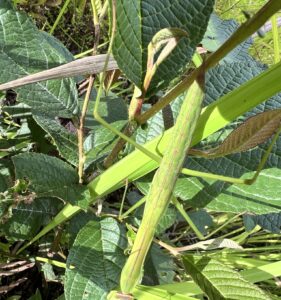
A giant mantis in its native hills
The Chinese mantis is famous worldwide, but most people meet it as an introduced species in North American gardens. Seeing one in Medog, Tibet, on 7 August 2024, was seeing it at home, in the forests where it has always belonged.
This is Tenodera sinensis, the Chinese mantis, one of the largest mantises in the world, a member of the family Mantidae (order Mantodea). Females can reach roughly ten centimetres long, and they come in shades of green or brown that match the vegetation around them. The long pronotum and spined raptorial forelegs make the hunting posture unmistakable, even from a distance.
It is an ambush predator, sitting motionless on vegetation and striking at anything that wanders within reach: crickets, grasshoppers, butterflies, even other mantises. The strike takes a fraction of a second, and the forelegs close like a trap lined with teeth. Mantises have eyes that cover most of their head and a neck flexible enough to look over their own shoulder, which lets them track prey without moving an inch. Males are smaller and lighter than females, a difference that becomes obvious when a pair meets in autumn. The eggs are laid in a foamy case called an ootheca that hardens into a tough, weatherproof shell, and in China this case, known as sangpiao, has a long history in traditional medicine.
In the late 1800s, Chinese mantis egg cases were shipped to North America as biological pest control, and the species is now a familiar sight in eastern American gardens, hunting much as it does in the hills of Tibet. Some things travel well.
Fascinating write-up! I usually come across Tenodera sinensis here in North America as an introduced species, so it is special to see it in its native forests in Medog. Were the individuals you observed there mostly in the green or the brown form? And roughly how large was the biggest one you saw?
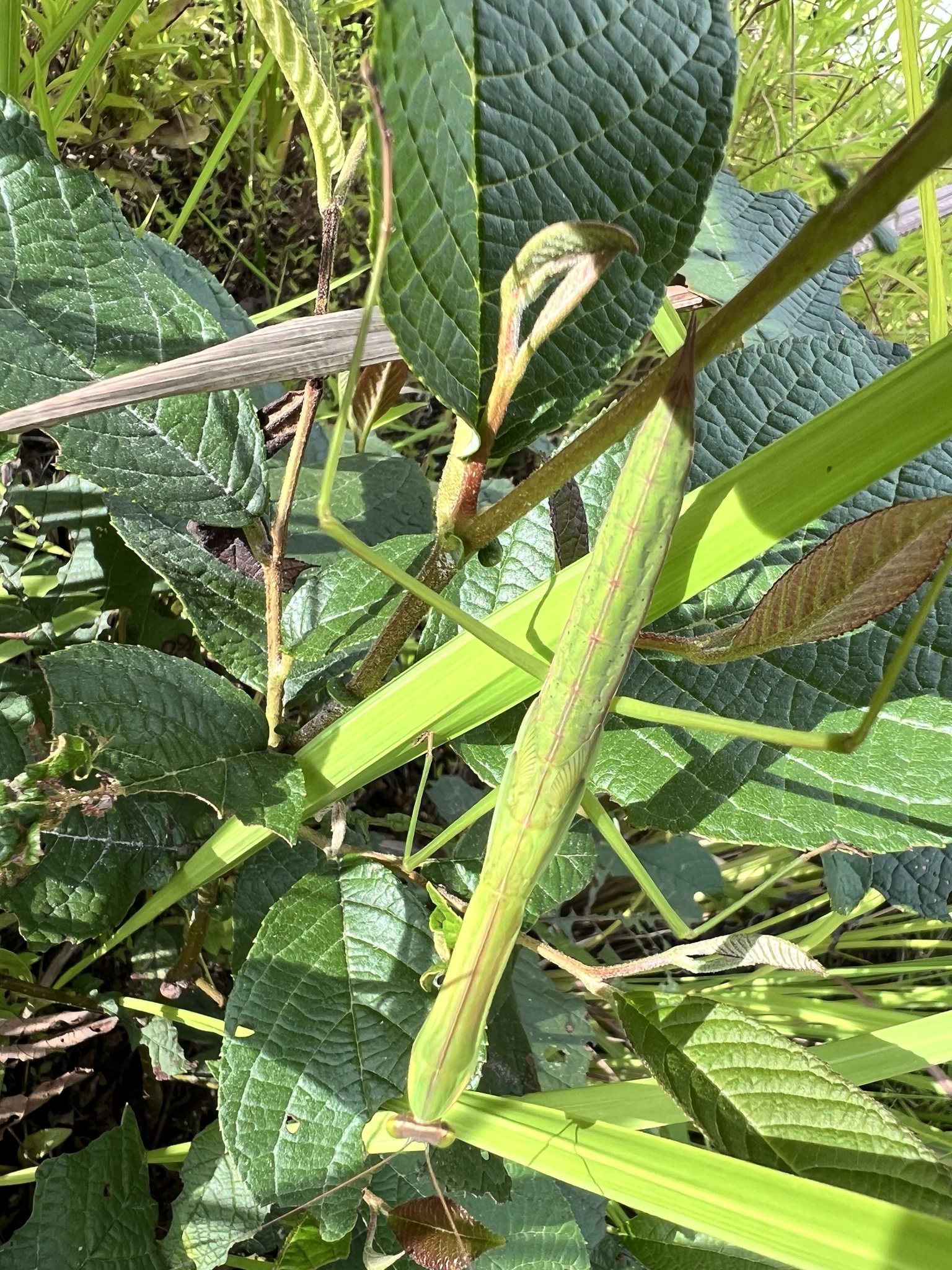
It was actually a single encounter that afternoon rather than a series of sightings, so I can’t offer a green-vs-brown ratio, sorry! That one individual was the green form, a bright green adult, and I didn’t get to measure it in the field. For what it’s worth, females of the species top out around 10 cm, and this one was clearly full-grown, but that’s about as precise as I can honestly get. I know the feeling of meeting it as a garden insect, I see them in yards around Pittsburgh too, and there was something special about watching one in the forest it originally came from. The green form made a lot of sense there, the understory was lush and green that time of year.