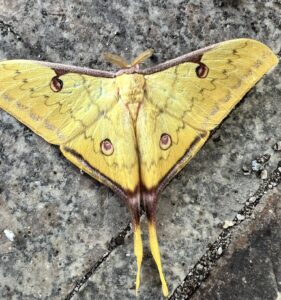
A moon moth that stayed long enough to admire
On the evening of 7 August 2024, along the Motuo highway in southeastern Tibet, a large saturniid drifted in and settled on a grey stone at the roadside. Moon moths are famously restless, but this one stayed put while I moved in for photographs, wings spread flat in the typical resting pose of the family.
The community identification places it as Actias parasinensis, the western Chinese moon moth, a species of the giant silkworm family Saturniidae (order Lepidoptera) described by Ronald Brechlin in 2009. Its name means “beside sinensis“, pointing to its closeness to the Chinese moon moth Actias sinensis (华尾大蚕蛾). Our own site already hosts its neighbour, the Indian moon moth Actias selene, photographed in the same region days earlier; the moon moths of this region are a confusing complex of closely related species, and distinguishing them in the field takes a careful eye. Most published records of A. parasinensis come from the eastern Himalaya and Southeast Asia, which makes this Medog sighting a fitting piece of the same picture.
Up close, this individual showed wings in a pale yellowish green, each hindwing drawn into a long, thin tail. Those tails are more than decoration: experiments have shown that the twisted tails of moon moths act as decoys, drawing bat echolocation strikes away from the body and buying the moth a real chance to escape. As adults, moon moths have no functional mouthparts. They never feed, and the entire winged life is a short, high-stakes sprint to mate and lay eggs.
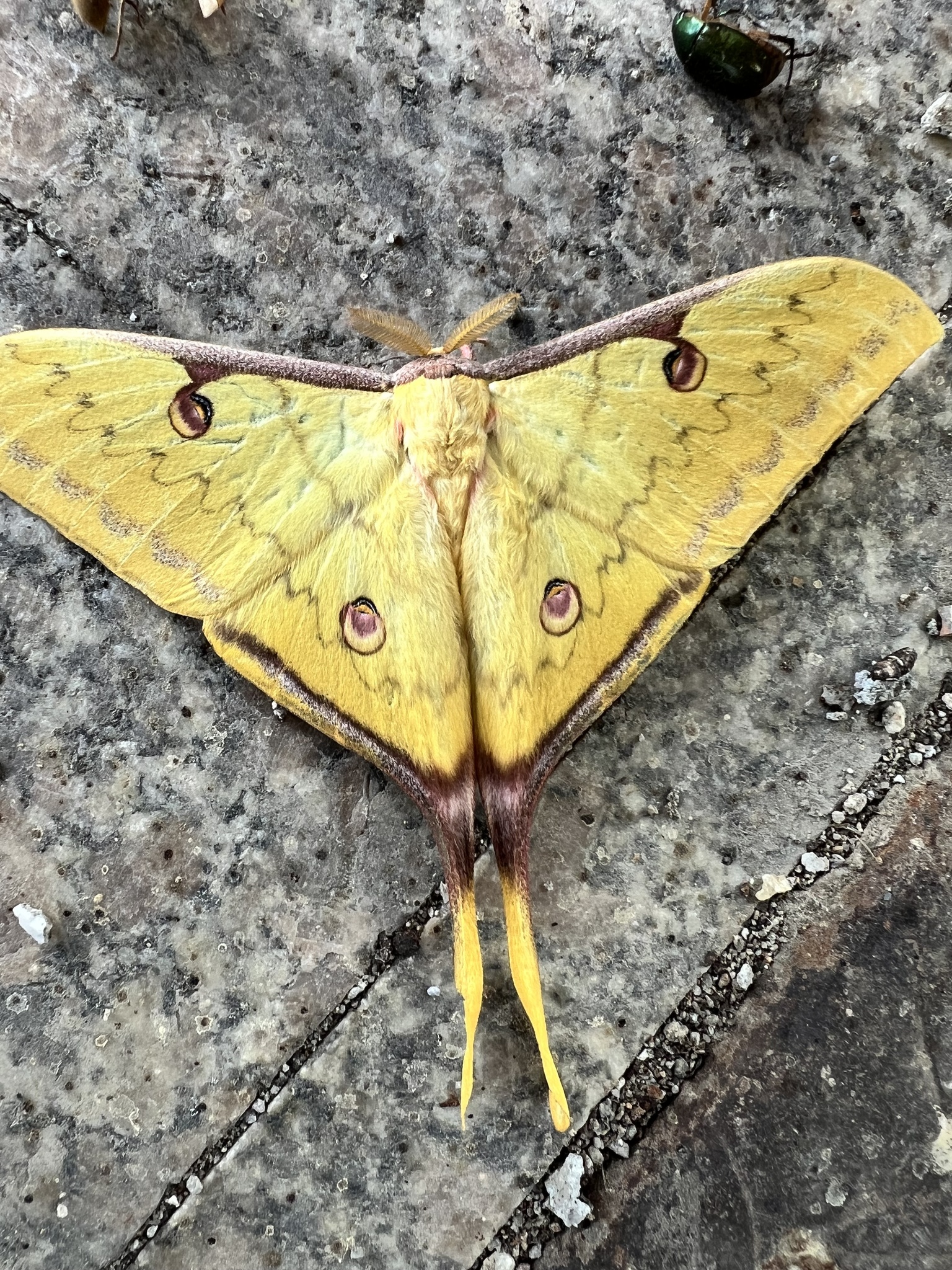
Seeing one at rest, wings spread on bare rock, is a reminder of how much of a moon moth’s life happens in the dark and how little of it is spent flying.
Beautiful find — catching one actually sitting still is more than I usually manage with moon moths. Two things I have always wondered about these tailed saturniids: since the hindwing tails seem to work as bat decoys, do they lose much of that effect once the tails get worn and torn late in the season? And with the mouthparts gone in the adult, roughly how long do they actually last if they do not find a mate right away — just a few days, or can they stretch it further? Also, given how similar it is to A. sinensis, did you see any 华尾大蚕蛾 in the same area?
On the tails, the decoy works because the twisted tail ends make a good acoustic target for a bat’s echolocation, and that mechanism does depend on the tails being intact. Once they are torn down to stubs late in the season the reflector is smaller and less asymmetric, so the effect is presumably weaker, but as far as I know nobody has tested worn tails against intact ones. The other thing to keep in mind is timing: the anti-bat benefit matters most during the early dispersal flight, when the moths are moving through unfamiliar habitat, and by the time the wings are shredded most of the flight is already done.
On lifespan without a mate, it is short. Saturniid adults generally last about a week, sometimes a little more, and Actias is in that range; a male that flies hard every night will run out sooner than a female that mostly sits and waits. Nobody gets much past ten days.
On A. sinensis, no, I did not record one. The site has A. selene from the same region a few days earlier, and that was the moon moth I ran into on that trip. I have not yet seen 华尾大蚕蛾 in the field, so if you have one nearby, I would like to hear about it.