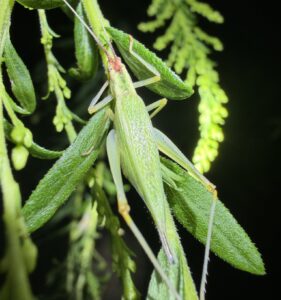
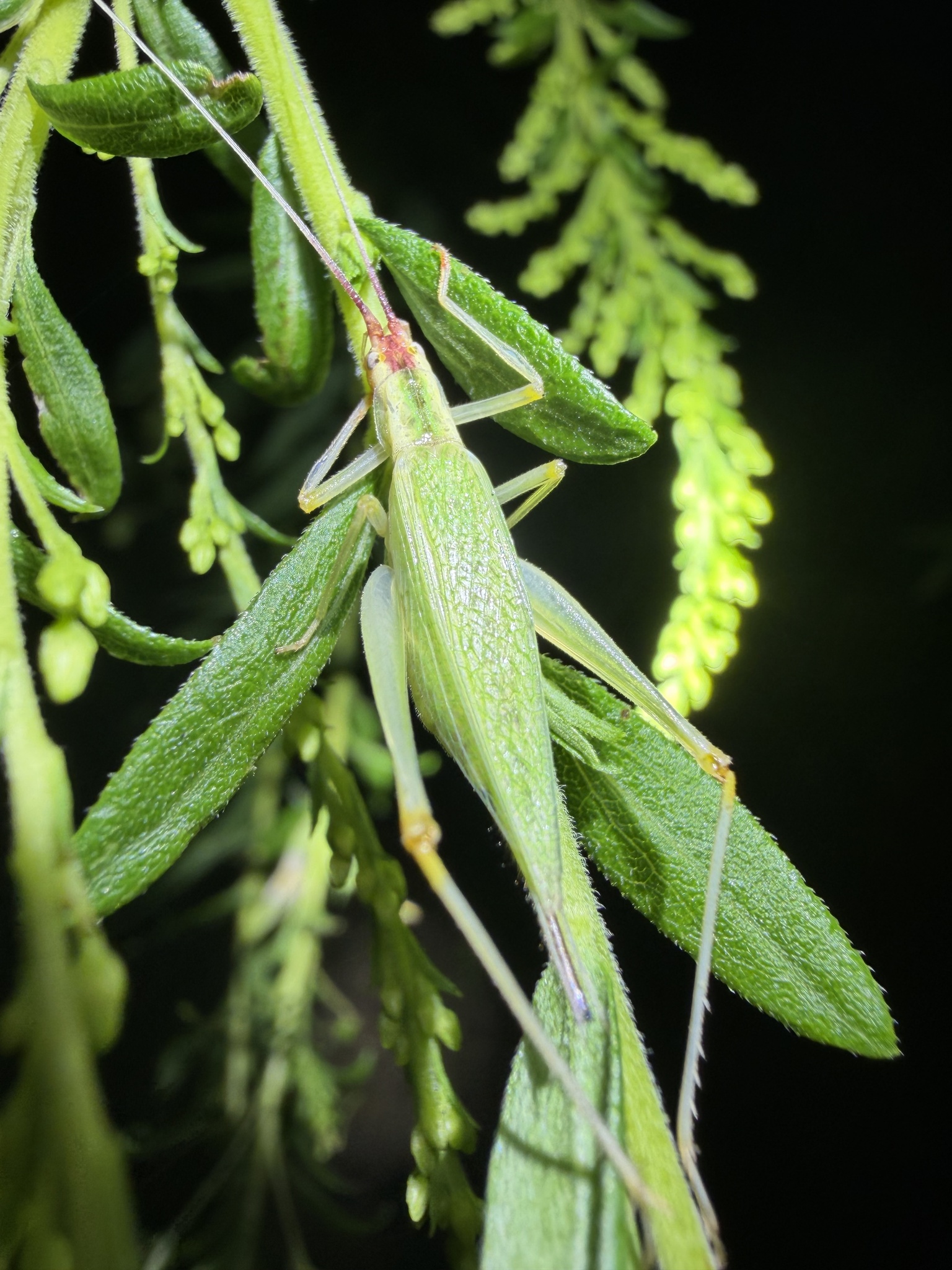
A pale green singer in the September dusk
On the evening of September 6, this slender cricket was sitting quietly on a plant outside the senior school at Shady Side Academy in Fox Chapel. In the dim light it was easy to overlook, a pale green sliver among the leaves, its wings folded flat over its back like a neatly closed coat.
It belongs to Oecanthus latipennis, the broad-winged tree cricket, a species of the cricket family Gryllidae (order Orthoptera) described by Riley in 1881. The identification is a community consensus on the observation: the broad, flattened wing covers that give the species its name — latipennis, from the Latin latus (broad) and penna (wing) — are a signature feature of the males, along with the slender build and translucent pale green typical of the tree crickets.
Tree crickets are creatures of the night. The males sing from vegetation after dark, each species producing its own steady trill, and the calls of the snowy tree cricket are so regular that their rate tracks air temperature closely enough to be used as a living thermometer. Broad-winged tree crickets range widely across the United States, singing from trees and shrubs, and females drill neat rows of holes into plant stems and twigs with their ovipositors to lay eggs, which wait out the winter and hatch the following spring.
By day they are masters of hiding in plain sight, their pale green matching the leaves they rest on. I left this one to its evening perch and its quiet business, glad the camera had caught it before the light went entirely.
The piece mentions snowy tree crickets being used as a living thermometer — does that counting trick work with broad-winged tree crickets too, or is their trill too irregular to read temperature from? Beautiful find either way.
That trick is built around the snowy tree cricket (Oecanthus fultoni), and latipennis doesn’t really cooperate. Snowy tree crickets give discrete chirps, only about 2.8 per second at 25 C, which is what makes them countable: time 13 seconds, count the chirps, add 40, and you get Fahrenheit. Broad-winged tree crickets instead give a loud continuous trill, about 54 pulses per second at 25 C and around 3 kHz, with no gaps between chirps to count. It isn’t that the song is irregular, it’s remarkably steady, just too fast and seamless for the count-and-add recipe. The rate rises with temperature like the rest of the genus, but reading it would take a recording and a species-specific calibration rather than mental arithmetic at dusk. Even for snowy tree crickets, the honest version of the trick is one you calibrate yourself against a thermometer near the singing male.