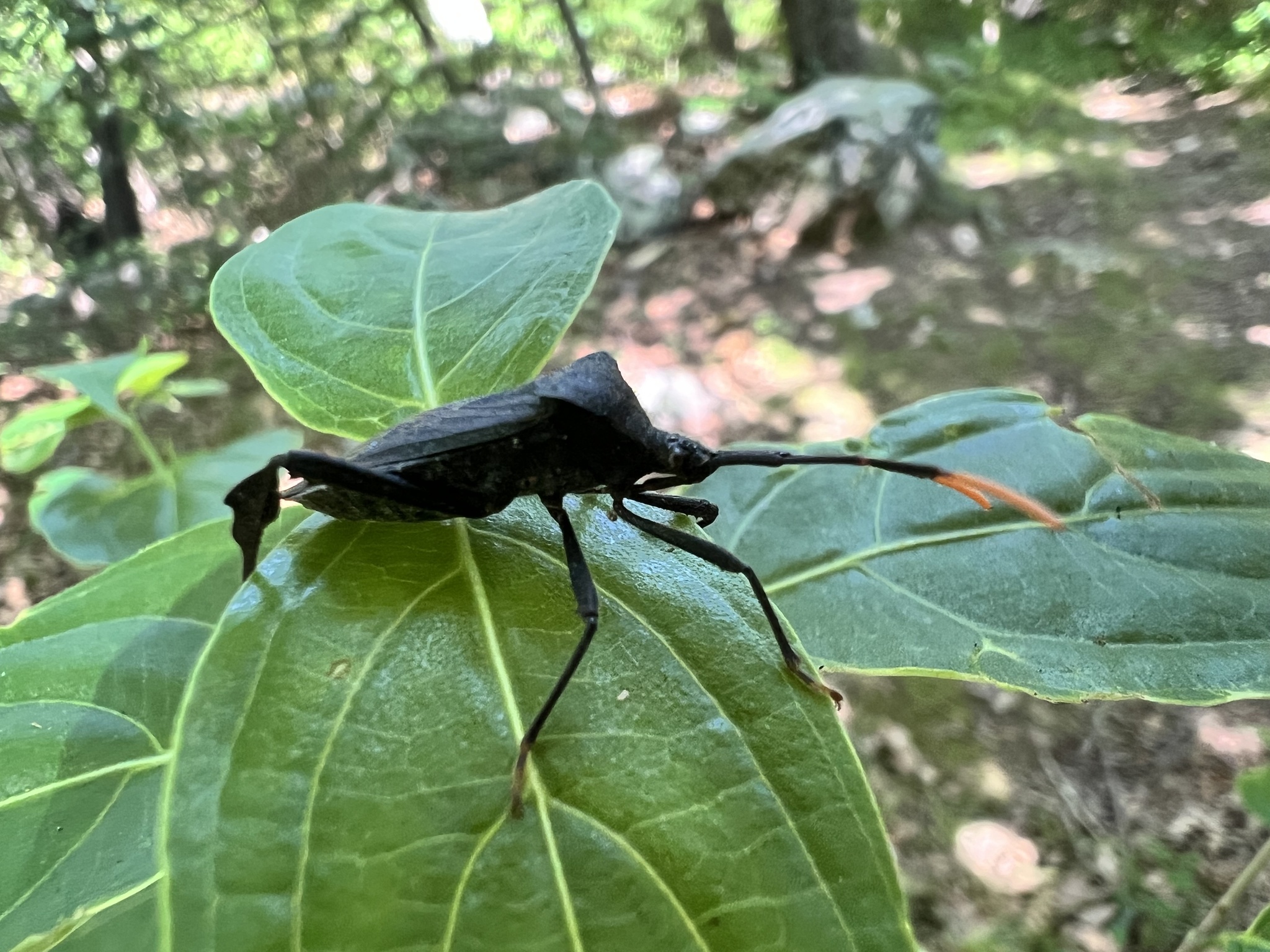
A leaf-footed bug with a red-tipped antenna
Late July in Rhode Island, and this true bug came into view during a summer walk. It was a large one, with a sturdy body and a head that looked lightly armed, but the detail that gave it away was at the far end: the last segment of each antenna glowed reddish-orange, a small flag against the brown body. It let me get close, which is typical of a bug that trusts camouflage more than speed.
This is Acanthocephala terminalis, a leaf-footed bug of the family Coreidae, order Hemiptera. The genus name Acanthocephala means spiny head, and the species name terminalis points to that coloured antenna tip, which makes identification easy once you know to look for it. Coreidae is a large family of true bugs found around the world, and most of its members share the same slow, sap-sipping way of life.
Leaf-footed bugs are plant feeders. They pierce stems, leaves and fruit with needle-like mouthparts and sip the sap, and the hind legs of the adults are flattened into leaf-like expansions that help them disappear among the foliage they feed on. Like many coreids, the young nymphs often gather in groups on their host plants before dispersing as adults. When disturbed, many coreids release a strong scent from glands near the thorax, a warning that works far better than a bite.
Every summer bug has its niche, and the leaf-footed bugs are the slow, sap-sipping browsers of the undergrowth. I noted the red antenna tips, thanked it for the easy identification, and moved on to find whatever was next.