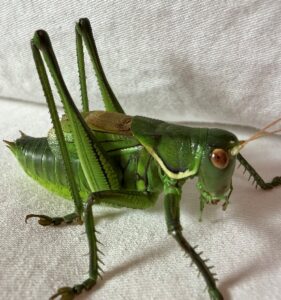
The great green singer of northern China
Among green leaves, a large katydid sat in plain sight, trusting its colour to hide it. It was a deep, solid green, the green of a well-fed herbivore, and it did not move even when the camera came close. This was a wild adult male, big and built for sound.
This is Gampsocleis gratiosa (Walker, 1869), one of the most famous singing insects of northern China. In Chinese it is called guo guo (蝈蝈), and in the region around Beijing it has been kept in cages for its loud, penetrating song for generations. The species name gratiosa means “graceful.”
It belongs to the family Tettigoniidae, the katydids. It is a large species: the male uses well-developed forewings with a file-and-scraper apparatus to produce a strong trill, mostly in late summer. It is omnivorous, feeding on leaves and also on smaller insects when it can catch them.
Colour varies with environment and individual: most are green, but brown forms occur too, and captive-reared individuals can differ noticeably from wild ones. In the wild around Beijing it is an unmistakable presence in late summer, calling from bushes and tall grass after dusk.
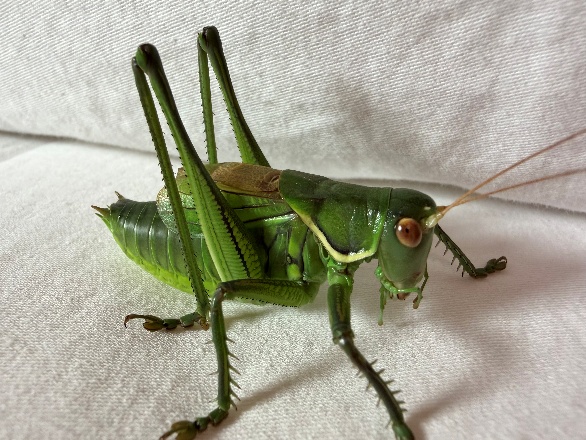
Nice write-up. Are the brown colour forms tied to drier or browner habitats, or do they show up randomly in the same green populations? Also wondering how long a captive-reared male usually keeps singing in a season compared with a wild one.
Both, honestly, and they are hard to separate. In this species the brown forms are more common in drier, sunnier, browner places and they also turn up more often late in the season, which fits the idea that humidity and background during the nymphal stages push the colour one way or the other. But green and brown do appear side by side in the same population, and Chinese breeders treat colour as at least partly heritable, so it is not a clean habitat switch.
On singing, wild males here start in midsummer and keep going until the nights turn cold, call it two to three months, then they fade and die off around the first hard frost. A captive male with steady warmth and regular food can keep singing much longer than that, well into winter, which is the whole basis of the caged guo guo tradition around Beijing. That is the warm cage doing the work rather than the insect being naturally longer lived, and it does depend on how well the individual was reared, since poorly kept males often go quiet early.