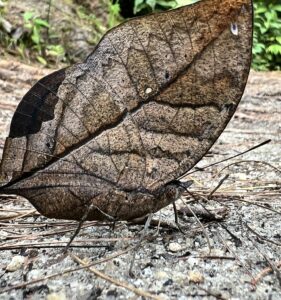
A dead leaf that turns into a blue butterfly
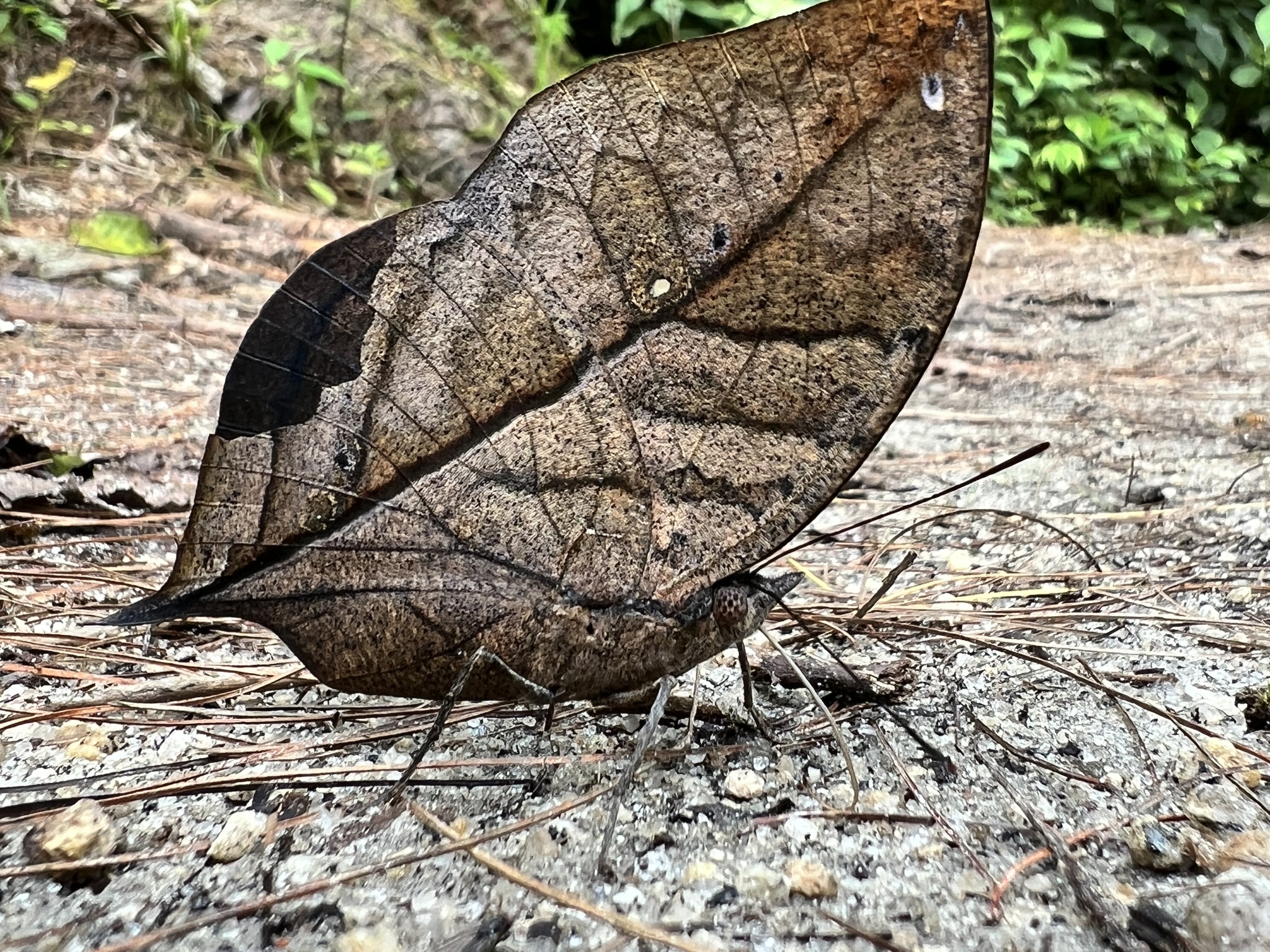
I met this one in Medog, Tibet, in August 2024, and it took me a moment to realise I was looking at a butterfly at all. The leaf mimicry is the whole point of this species: with the wings closed it is simply a dead leaf, brown and veined, with a notched edge and a stalk-like tip that passes for a leaf stem.
This is Kallima knyvettii, known as the scarce blue oakleaf, a member of the brush-footed butterfly family Nymphalidae (order Lepidoptera). The genus Kallima is the textbook example of leaf mimicry; the undersides of the wings reproduce the midrib and side veins of a leaf in such detail that the disguise works at a few centimetres. Some individuals even carry small dark spots that read as patches of mould, which is the kind of attention to detail natural selection is famous for.
When the butterfly takes off, the disguise vanishes: the upperside flashes deep blue, which is exactly where the common name comes from. Then it lands again, and the blue folds away into dead-leaf brown as if it had never happened. One animal, two completely different identities, and it switches between them in a heartbeat.
Taxonomists still argue over where the blue oakleaf species boundaries lie, and the name is sometimes written Kallima knyvetti, with one t, or treated as part of a broader species. To me that hardly matters. A dead leaf that turns into a blue butterfly is worth a second look whichever name it wears.
Lovely write-up! I have a question about the mimicry — is the dead-leaf disguise mainly on the underside for both sexes, or do males and females differ much in how their wings look when closed? Also, do the small mould-like dark spots appear in all individuals or just some?
Both sexes carry the disguise, it’s the underside that does the work in every Kallima I know. When the wings are shut, male and female both look like the same dead leaf, with the midrib and side veins drawn in fine detail. The real differences between the sexes are elsewhere: females run larger, and their forewing tip tends to come to a longer, more leaf-stalk-like point. Females can also come across slightly redder or duller underneath, and paler in the mottled patches, but that’s tone, not a different design, so a resting butterfly is hard to sex by eye.
The dark spots are a different story, they vary from individual to individual. Some individuals show those little mould-like dots quite clearly, others are nearly plain brown, and I’ve seen plenty in between. The old descriptions of the closely related orange oakleaf (Kallima inachus, often lumped with this one anyway) mention the spots as typical but stress the ground colour and marking intensity shift with the individual and with the season, wet-season forms tend to be darker and richer. So no, not every individual wears them, which makes sense if the disguise is really just about looking like ‘a dead leaf’ and the odd fungal patch is a bonus some leaves get.