A pale ghost rising from the forest floor
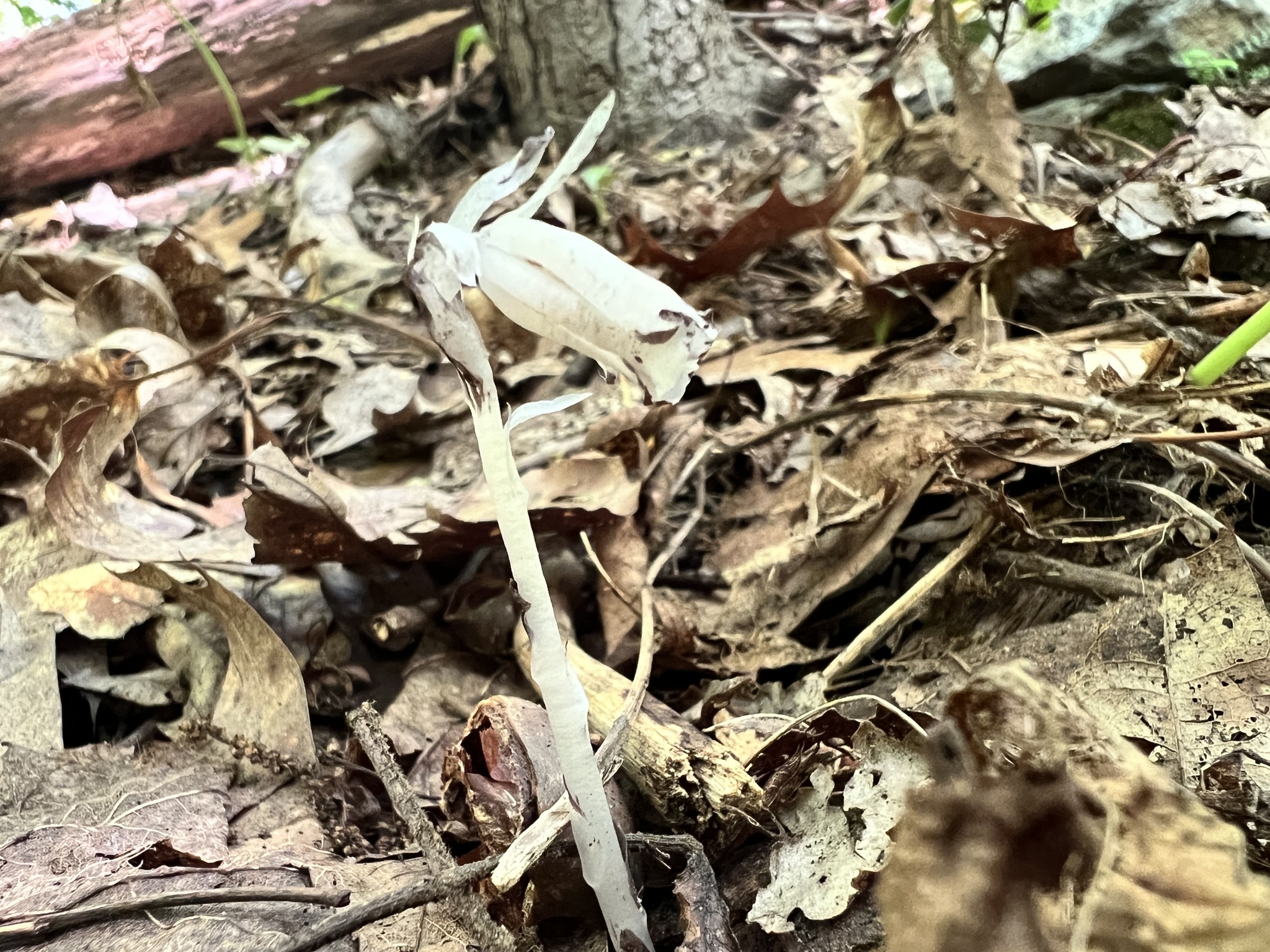
On a humid morning in late July I was walking a shaded trail in Rhode Island when something white caught my eye among the fallen leaves. A single waxy stem stood upright in the brown litter, topped by a flower that nodded like a question mark, with a tree trunk rising in the background. It could have been an odd mushroom, but it was a plant, and it was not green at all.
This is Monotropa uniflora, known as ghost pipe, Indian pipe, or corpse plant. It belongs to the heath family Ericaceae, in the order Ericales. The species name uniflora means “one flowered,” and it is easy to see why: each stem carries a single bloom and rarely grows taller than a hand’s height.
The lack of green is not an accident. Ghost pipe contains no chlorophyll and never photosynthesizes. Instead it draws its nutrition through a network of soil fungi, which in turn tap sugars from the surrounding trees. It is a mycoheterotroph, a quiet freeloader in the woodland economy, and it only appears where the underground fungal web is healthy. After flowering, the whole plant darkens and finally blackens, which explains another of its names, corpse plant.
Finding it always feels like a small event. You do not hunt for ghost pipe; it finds you, pale and unhurried, in the darkest part of the woods. The old name Indian pipe comes from its shape, each stem a tiny pipe with the bloom as the bowl, and it suits a plant that seems to do everything slowly, on fungal time.