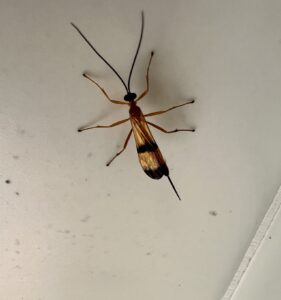
A wasp built like a needle
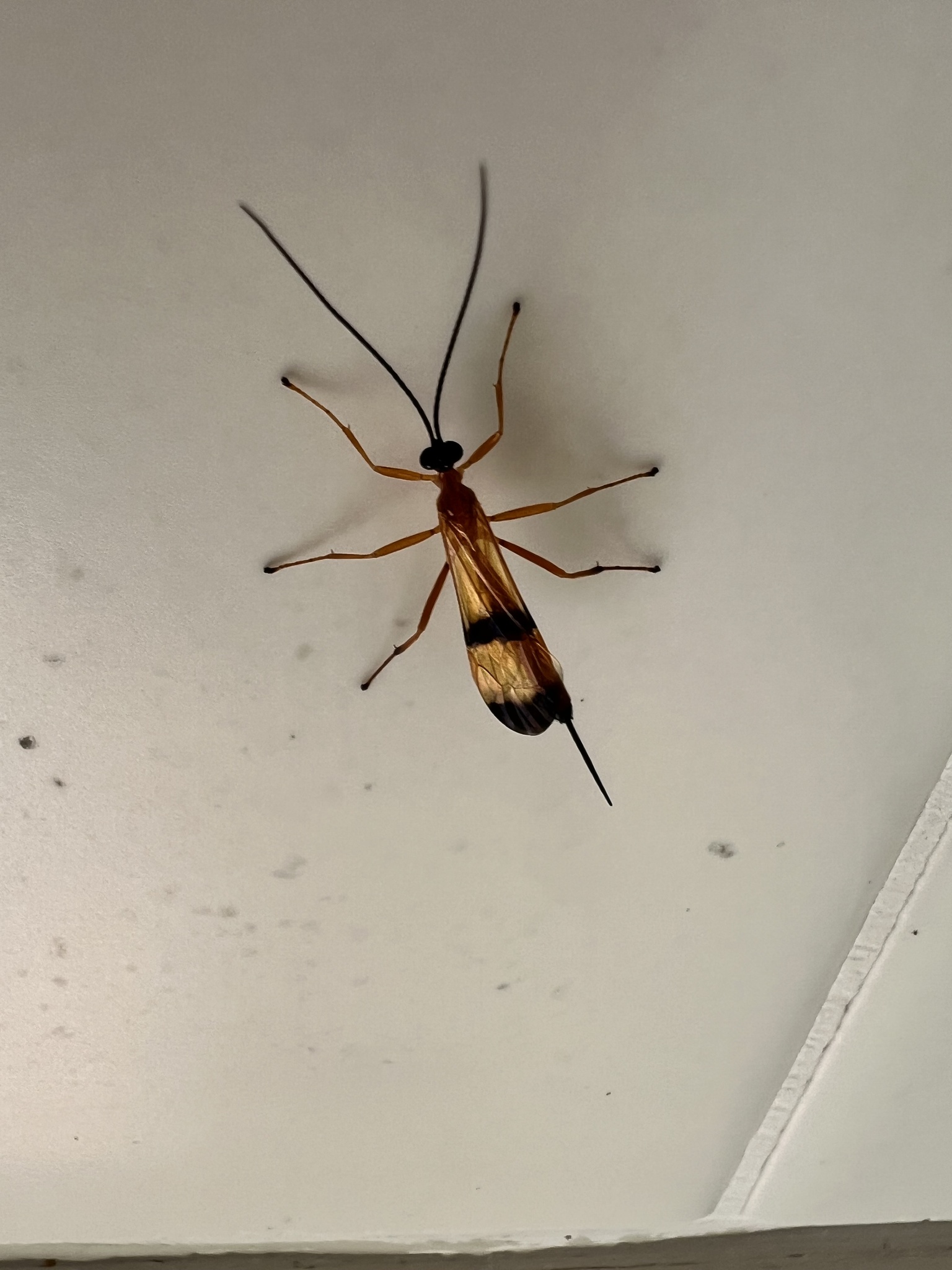
On July 20 in Rhode Island, a long, thin wasp drifted onto a leaf in front of me and folded its wings, and for a moment I thought a pine needle had landed there. Then the needle walked. Slender beyond reason, with a thread-like waist and an abdomen that tapered to a fine point. It sat in the sun for a minute, antennae working, then launched itself into the grass as suddenly as it had arrived.
It was Acrotaphus wiltii, an ichneumonid wasp in the family Ichneumonidae, order Hymenoptera. Ichneumonids are parasitoids: the females use a long ovipositor to lay eggs on or inside other arthropods, and the larvae develop by feeding on the host, which sounds grimmer than it is. From a gardener’s perspective, these wasps are free pest control.
Species in this genus have been recorded as parasitoids of orb-weaving spiders, and the females are known to track down their prey in the web. That long ovipositor is not a stinger; it is an egg-laying tube, and the wasp is generally not interested in people at all. In the wild, ichneumonids like this one are part of a quiet web that keeps caterpillar and spider populations in balance, and a garden with a healthy wasp population is usually a garden with fewer pests.
The family name comes from the Greek ichneumon, meaning tracker, a name the ancient Greeks also gave to the mongoose, because both are hunters that track their prey with skill. A tiny needle-bodied tracker, working the margins of a Rhode Island field, and I was glad to have met it.
Nice find — a walking pine needle is a good way to put it. I had read that some Acrotaphus and related polysphinctine ichneumonids do not just lay an egg on the spider: they apparently make the host build a modified web (a “cocoon web”) before the larva finishes it off. Does that happen with A. wiltii as far as you know, or do the larvae here just pupate in the spider normal orb? And the one you saw — was it actually working an orb weaver web, or just passing through the grass?
Yes, that manipulation is the signature move of the polysphinctine group, and Acrotaphus sits inside that group, so the cocoon web story applies in principle. The larva rides on the spider, then induces it to build a modified web, kills it, and pupates in that structure, which is sturdier and better anchored than a normal orb. How much of that has been documented for A. wiltii itself I would have to check, but it is the pattern for the genus group as a whole.
The individual I photographed was on a leaf, not on a web, and it dropped into the grass a moment later, so it was commuting rather than working that day. I have not yet seen one on an orb weaver web, which is the observation that would settle it for this species.