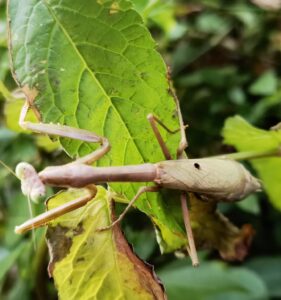
A native mantis in a Florida summer
Florida, 11 June 2024. A green mantis was doing what mantises do best: absolutely nothing, with total focus. It was a Carolina mantis, one of the few mantises truly native to North America, and it looked perfectly at home in the middle of an American summer.
This is Stagmomantis carolina, the Carolina mantis, a member of the family Mantidae (order Mantodea). It is smaller than the introduced Chinese mantis that now shares its range, and it comes in green or brown, matching the background it hunts from. The name points to the Carolinas, where the species was first described, but its range covers much of the eastern United States, from the Atlantic coast well into the Midwest.
Like all mantises it is an ambush predator, striking with spined forelegs at anything that wanders within reach, from flies to grasshoppers larger than itself. In summer the females lay their eggs in a foamy ootheca that hardens on a twig and carries the next generation through the winter. The case is small and brown, easy to miss, but it can hold dozens of eggs. Late in the season, the winged males fly at dusk in search of females, one of the few times a mantis takes to the air. The young hatch the following spring and scatter, each one starting the hunt from scratch.
In American gardens, the big mantises you usually meet are immigrants, so finding the native species is a quiet pleasure. It needs no introduction to do well in its own country, and it has been doing exactly that for far longer than the rest of us have been around.
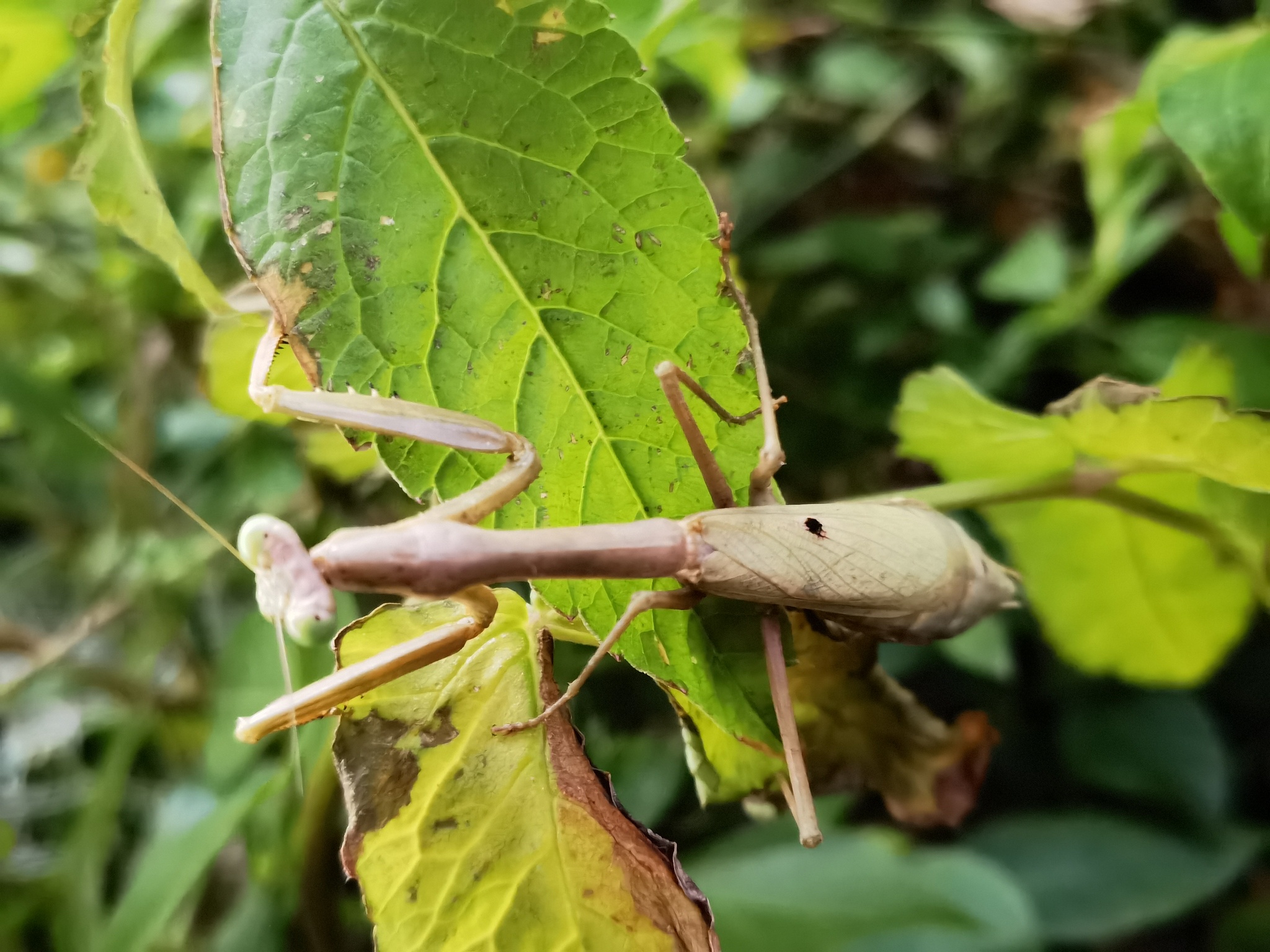
Nice portrait – the green form against green really shows why they are easy to walk past. You mention it is smaller than the introduced Chinese mantis; in the field, is the main giveaway the size and the shape of the ootheca, or can you also use the markings on the inside of the forelegs? And are the females around you mostly this green form, or do they vary more toward brown?
Size and the ootheca are the two I would lean on. Stagmomantis carolina is clearly smaller and slimmer, and its ootheca is the giveaway once you know it: long, narrow and beaded, laid lengthwise along a twig, against the big frothy mass a Chinese mantis leaves behind. Wing length helps as well, since Carolina females often have wings that stop short of the abdomen tip, which you will not see on Tenodera. The foreleg markings are useful but fiddly, and they work better under a lens than in the field.
Around me the green form is the common one, with browns turning up every so often, and my impression is that browns are more frequent late in the season and in drier, browner places.