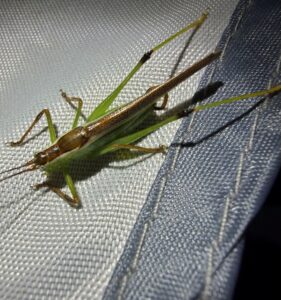
Small green heads in the grass
Hidden among green stems, these little katydids were easy to walk past. They were small, slender and green, with long antennae and cone-shaped heads that pointed forward like tiny arrowheads. Only movement gave them away.
These are conehead katydids, members of the subfamily Conocephalinae in the family Tettigoniidae (order Orthoptera). The group has sometimes been treated as a separate family, Conocephalidae, but current classification (GBIF) ranks it as a subfamily within the katydids. The English name comes from the pointed, conical head that is the group’s signature.
Coneheads are small to medium katydids that live among grasses and herbs. They are mixed feeders: most take grass seeds, flowers and leaves, and many also eat small insects when the chance appears. Their long, thin antennae and slender bodies make them hard to spot in the grass, and their song, often a rapid ticking or buzzing, is a common sound of summer fields.
These individuals were recorded at subfamily level; identifying a conehead to genus or species usually requires a close look at the head, pronotum and the male genitalia.
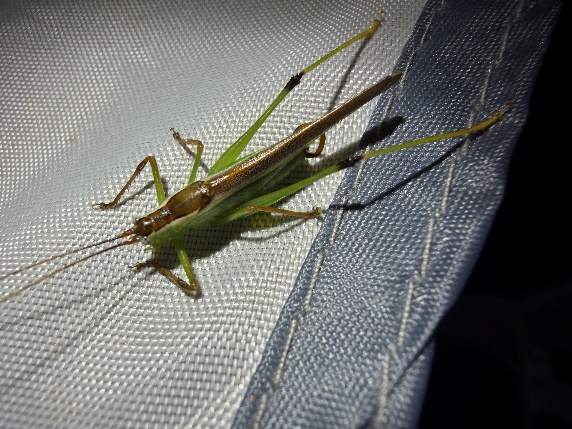
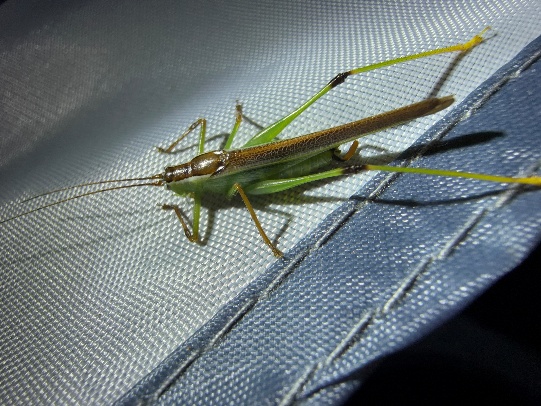
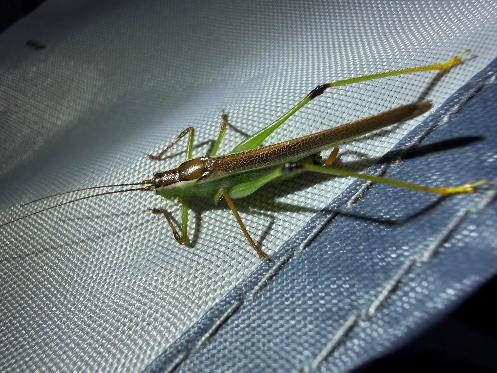
How long it can live?
Most coneheads run one generation per year: the eggs hatch in spring, the nymphs grow through summer, and the adults you see in late summer and fall live for roughly a month or two before the first hard frost. So the full life cycle from egg to adult spans close to a year, but the winged adult stage is the short part of it. The species carries through winter as eggs tucked into plant stems or soil, not as adults. Exact adult lifespan shifts a bit with species and how warm the season is, but a few weeks to a couple of months is a fair range.