Waxy wings and a taste for sap
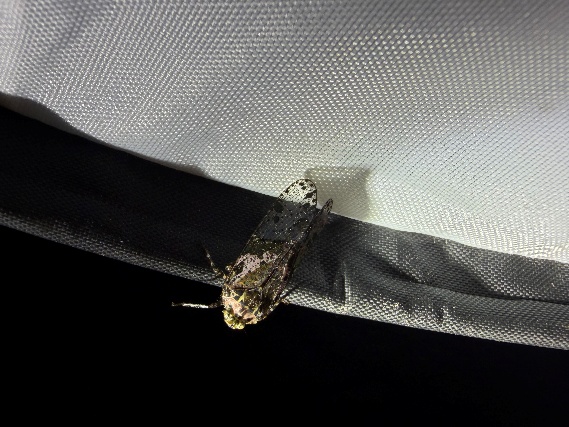
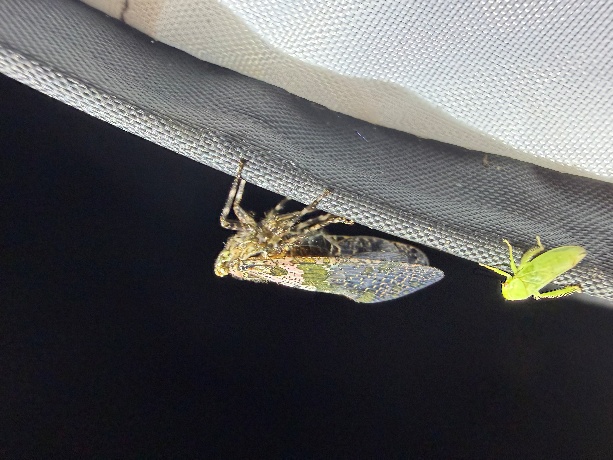
It held its wings like a little tent, patterned and translucent, looking more like a small moth than a true bug. When it hopped, it moved sideways and off the stem in the quick, awkward way that planthoppers have.
This is Limois kikuchii Kato, 1932, a lanternfly in the family Fulgoridae (order Hemiptera, superfamily Fulgoroidea). Within Fulgoridae it belongs to the subfamily Aphaeninae, a group whose Chinese members include some of the most richly patterned lanternflies in the region.
The identification of this one was revised in August 2026: earlier it was left at superfamily level, but the wing pattern fits L. kikuchii closely. The forewings carry an irregular dark brown transverse band at the basal two-fifths, reddish yellow along the costal area and the basal third, and scattered brown patches over a hyaline apical half. The hindwings are reddish orange on the basal half and hyaline beyond. The frons bears three longitudinal carinae, and the pronotum is brown with a broken dark band on each side of the median carina. Males measure about 9.4 to 10 mm in body length, females 9.5 to 10.5 mm, with wingspans of roughly 3.3 to 4.1 cm.
The genus Limois was revised by Wang et al. (2020), who re-described all extant species and illustrated the male genitalia. Species that look alike in external view, including L. kikuchii, L. westwoodii and L. bifasciatus, are best told apart by the genitalia, so this kind of identification rests on careful comparison rather than a quick glance.
Like other planthoppers, Limois feeds on plant sap with piercing-sucking mouthparts. The species is known from northern China, including Beijing, Shaanxi and Hebei, as well as Korea. The name honours the collector K. Kikuchi, who took the type material in Manchuria in 1932.