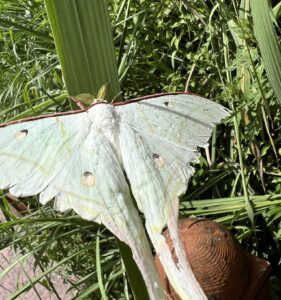
A pale green ghost in the Medog night
Medog, Tibet, August 2024. Even in a region famous for spectacular insects, this one stopped me cold: wings the colour of new leaves, each hindwing drawn out into a long, elegant tail. The Indian moon moth does not hurry. It drifted through the warm, damp air of the rainforest as if the night belonged to it, and for a few minutes, it did.
This is Actias selene, the Indian moon moth, a member of the giant silkworm family Saturniidae (order Lepidoptera). It belongs to the same group as the Chinese moon moth, Actias ningpoana, which for a long time was treated as a subspecies of A. selene before being raised to full species status. Moon moths have no functional mouthparts as adults; they never eat, and their whole winged life is a short sprint to find a mate and lay eggs before running out of fuel.
The caterpillars are leaf-eaters, chewing their way through a range of broad-leaved trees and shrubs, and they are striking in their own right: green, plump, and studded with rows of knobs. By the time they spin their silken cocoons, they are among the largest moth larvae a forest can hide. Each generation waits out the winter as a pupa inside that cocoon, which is why the adults appear in such a narrow window of summer.
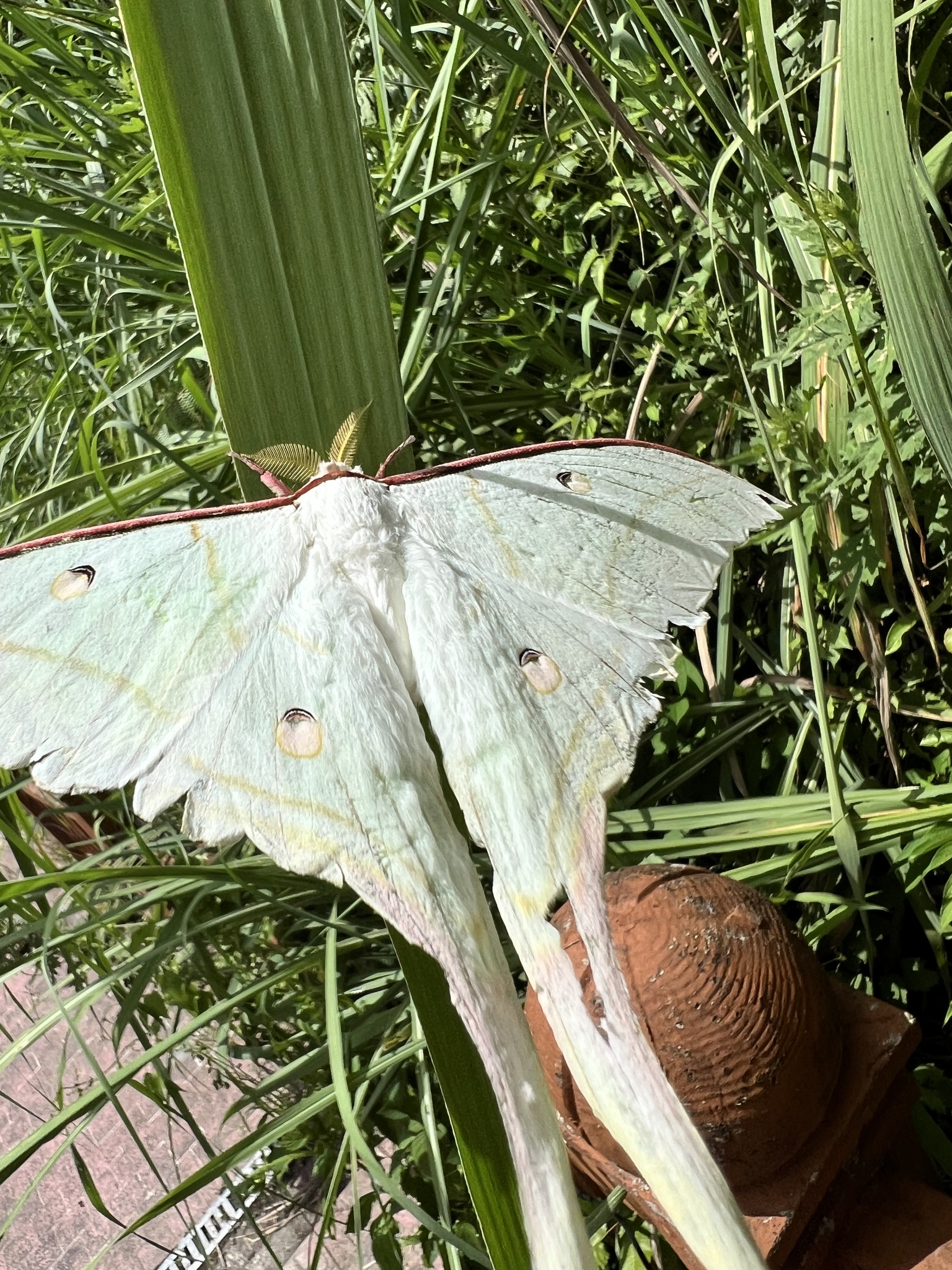
The long tails are more than decoration. Experiments suggest they help deflect the echolocation calls of bats, giving the moth a better chance of surviving its brief winged life. Seeing one in the wild is a reminder that the most beautiful things in the forest often have the shortest time to enjoy it.
请问它的尾突到底是怎么干扰蝙蝠回声定位的呢?是让蝙蝠误判位置,还是引导蝙蝠去攻击尾突来保命?之前在别的文章里看过类似的推测,想确认一下。另外成虫不吃东西的话,一般能活几天?
你之前看到的推测方向没错,实验证实是第二种:尾突不是让蝙蝠误判位置,而是当诱饵。
2015 年 Barber 等人发在 PNAS 上的实验(DOI: 10.1073/pnas.1421926112)直接用大棕蝠实测带长尾的天蚕蛾:蝙蝠飞行中发起攻击时,几乎都冲着蛾子旋转的后翅尾突去,咬空或只咬到尾巴,蛾子身体完好,存活率大幅提高。机制叫 acoustic deflection(声学偏转),尾突飞行时摆动会产生很强的回声,像假目标一样把攻击引离身体要害。它是被动的感官欺骗,和虎蛾那种主动发超声干扰(jamming)是两码事。
成虫寿命我也能给你一手数据:我养过绿尾大蚕蛾,成虫完全不吃东西,羽化后最短活 9 天、最长 17 天,7 只平均 12 天左右,活着就为交配产卵,全靠幼虫期攒的能量。