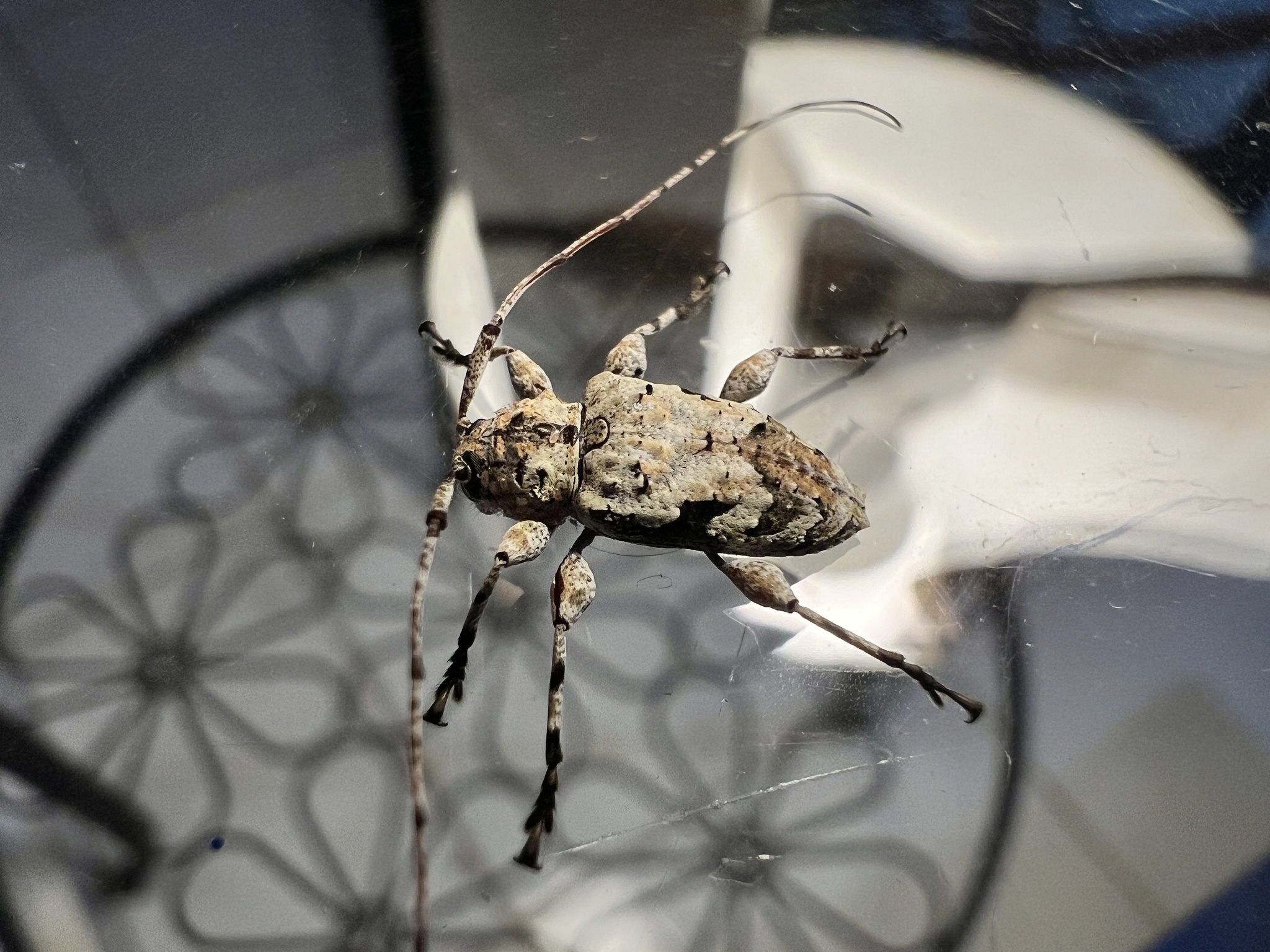
A banded longhorn on a Caribbean morning
On January 4 in the Dominican Republic, a slender beetle was resting on a low branch, and the first thing I noticed was the antennae: long, curved, and far longer than seemed practical. The second thing was the banded pattern across its wing covers, which gave it the look of something striped by a careful hand. The legs are long and the body narrow, and the whole insect has the neat, mechanical look of a creature assembled with care.
It was Leptostylopsis perfasciatus, a longhorn beetle in the family Cerambycidae, order Coleoptera. The species name means “fully banded,” and the elytra carry the barred markings that name promises. The genus name, from Greek roots for slender, suits an insect built on delicate lines.
Longhorn beetles are wood-borers as larvae: the grubs tunnel through dead or living wood, sometimes for a year or more, before emerging as adults. The adults are often found on trunks and branches, and many species visit flowers for nectar, though the adults do not live very long once they emerge. Their larvae, by contrast, can spend a year or more inside a branch, slowly converting wood into beetle. In the West Indies, the genus Leptostylopsis is a familiar part of the island fauna, with many species spread across the Caribbean.
Those extravagant antennae are not for show. In longhorns they carry dense arrays of scent receptors, so a beetle can detect a mate from a surprising distance. I have always thought of them as the insect equivalent of holding up a satellite dish. On a quiet Caribbean morning, this one was listening to the neighborhood.