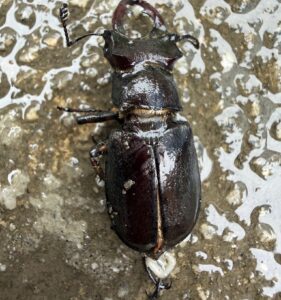
A dark giant of the wet forest floor
The ground was wet and rough, the kind of surface that blends into the forest floor, and for a moment I almost walked past it. Then the shape registered: a large, deep-coloured, rounded beetle with an enormous pair of horn-like mandibles sweeping forward from the head. Its mandibles, longer than the head itself, curved like a pair of sickles, and it sat in the open as if it had simply fallen out of the night and landed there.
This is Lucanus liupengyui, a stag beetle of the family Lucanidae, order Coleoptera, and a member of the genus that includes Europe’s famous Lucanus cervus, the classic stag beetle of old natural history books. The species name records the person the describer chose to honour, a reminder that even taxonomy keeps its own heroes. It is part of the remarkable stag beetle fauna of the Himalaya region around Medog, where the wet forests support an unusual richness of these giants.
Lucanus beetles share a familiar life story: larvae that spend years inside decaying wood, adults that live a short season on sap and fruit, and males that use their great mandibles in pushing contests for mates. In a forest as wet as this one, the wood never fully dries, and that is exactly what stag beetle larvae need to grow. The size of the jaws is often a signal of the male’s quality, and the contests are mostly shoving matches rather than bloodsport.
I knelt in the wet and photographed it from its own level. It was still sitting there when I stood up, patient as the forest itself.
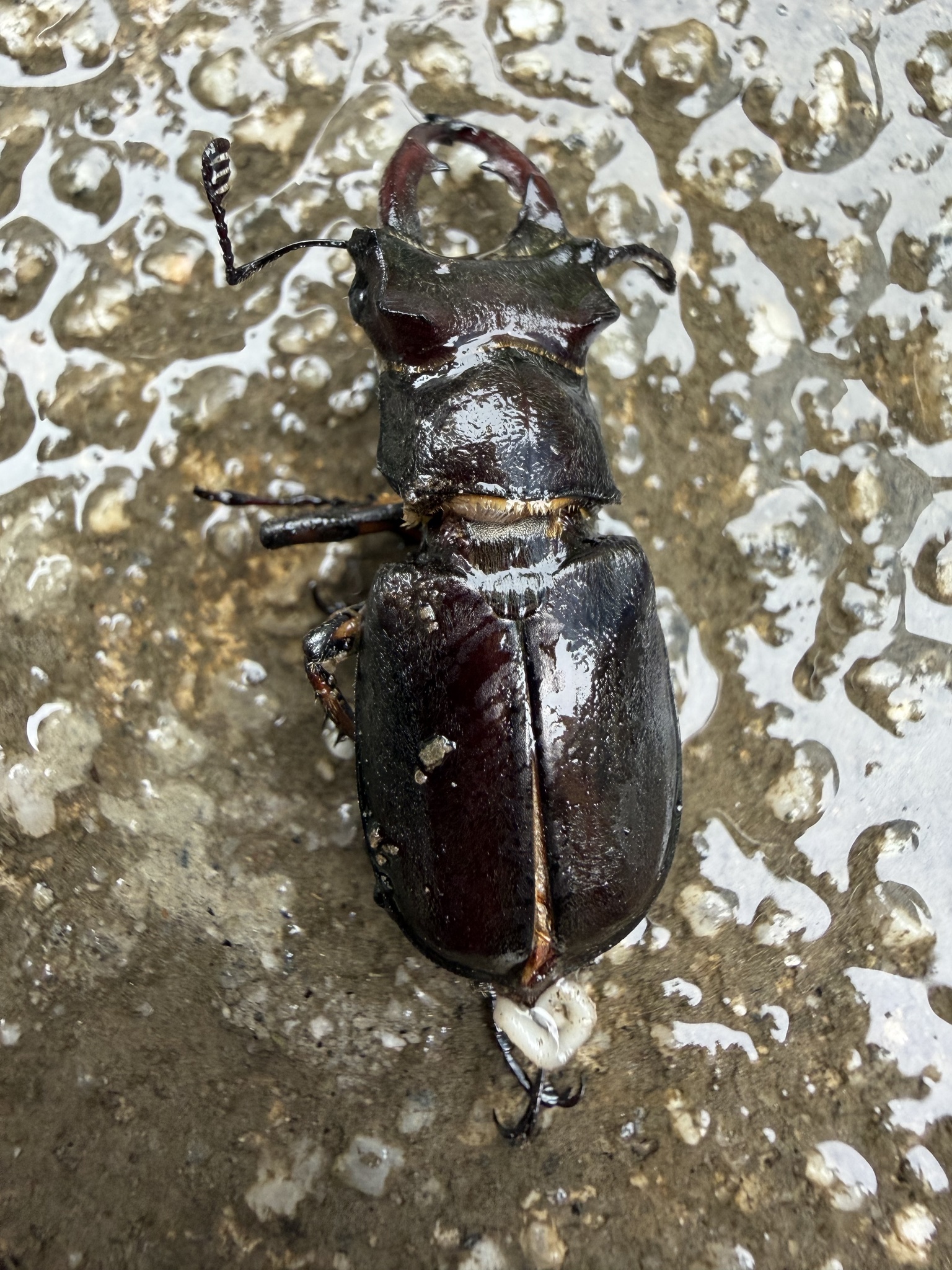
Great find — those sickle-shaped mandibles are impressive. How do you tell Lucanus liupengyui apart from its close relatives in the field, or is the locality around Medog the main giveaway?
Locality is a big help here but it isn’t a free pass. Lucanus liupengyui is only known from the wet forests of southeastern Tibet around Medog and Nyingchi, roughly 1,600 to 2,000 m, and it belongs to the Lucanus fortunei species group, so if you are standing in that forest the shortlist is short. The catch is that Medog has several large Lucanus overlapping, L. lunifer among them, so the locality narrows things down without settling them.
For males the mandibles do most of the work: overall curvature, how many inner teeth there are and where they sit (one strong basal tooth versus a row of small serrations), and the shape of the tip. Head and clypeus proportions, plus mandible length relative to the head, are worth shooting as well. Females are the hard part, where you are down to elytral punctuation, pronotum shape and ultimately genitalia, which is why records often stay provisional until someone with a specimen compares it against the original description.
Practically: get a straight dorsal shot of the head and mandibles plus a lateral one, note elevation and precise locality, and compare against Huang and Chen’s Stag beetles of China III (2017), where the species was described. Chinese breeder references give males about 36 to 43 mm and females 28 to 32 mm, which is a useful sanity check but not diagnostic on its own.